

July 24, 2023
What Makes Good Circuit Simulation Software: Factors to Consider in 2023

Share


The importance of circuit simulation cannot be overstated. It assists in the detection of potential design flaws, reduces the need for physical prototyping, and accelerates the development cycle. In 2023, current trends in circuit simulation include the integration of machine learning for predictive modeling, the move toward online simulators, and the adoption of more accurate modeling techniques.
Circuit simulators are typically categorized into analog and digital types. Analog simulators, like SPICE (Simulation Program with Integrated Circuit Emphasis), model continuous signals, while digital simulators model circuits that have a number of discrete states. Some circuit simulators, like Flux's circuit simulator, operate directly in your EDA's schematic diagram. With an understanding of your netlist and schematic diagram, these simulators help verify the functionality of your system.
Circuit simulation can either be performed offline with software installed on a local machine, or online via web-based tools. Online simulators offer several benefits, including accessibility from any device, collaborative features, and easy updates. However, they might be limited in computational power compared to offline options and can be affected by network issues.
Numerous circuit simulators have gained popularity due to their robust features and user-friendly interfaces. Some of these include:
The feature set of circuit simulation software can be broad, catering to a wide range of needs:
Circuit simulation has many advantages. It offers cost-effective circuit design by reducing the need for expensive prototypes. It increases efficiency by streamlining the design process. It improves design accuracy by allowing for extensive testing and validation. It also simplifies troubleshooting by highlighting problem areas in the circuit.

Despite its advantages, overreliance on circuit simulation can have some drawbacks. It can lead to a lack of hands-on experience and a limited understanding of physical circuit components, both crucial for practical applications. It can be difficult to properly simulate the behavior of complex PCBS with dynamic parts like integrated circuit
Being able to simulate a circuit is a critical aspect of modern electronic design. The variety of available simulators cater to diverse needs, offering features ranging from circuit design to PCB prototyping. While the benefits of using circuit simulation are substantial, it's essential to balance its use with practical, hands-on experience. As we look toward the future, we can expect even more advanced and intuitive circuit simulation technologies, further revolutionizing the electronics design landscape.


How hardware teams apply Git-style version control to PCB design — tracking revisions, collaborating safely, and maintaining a complete design history.

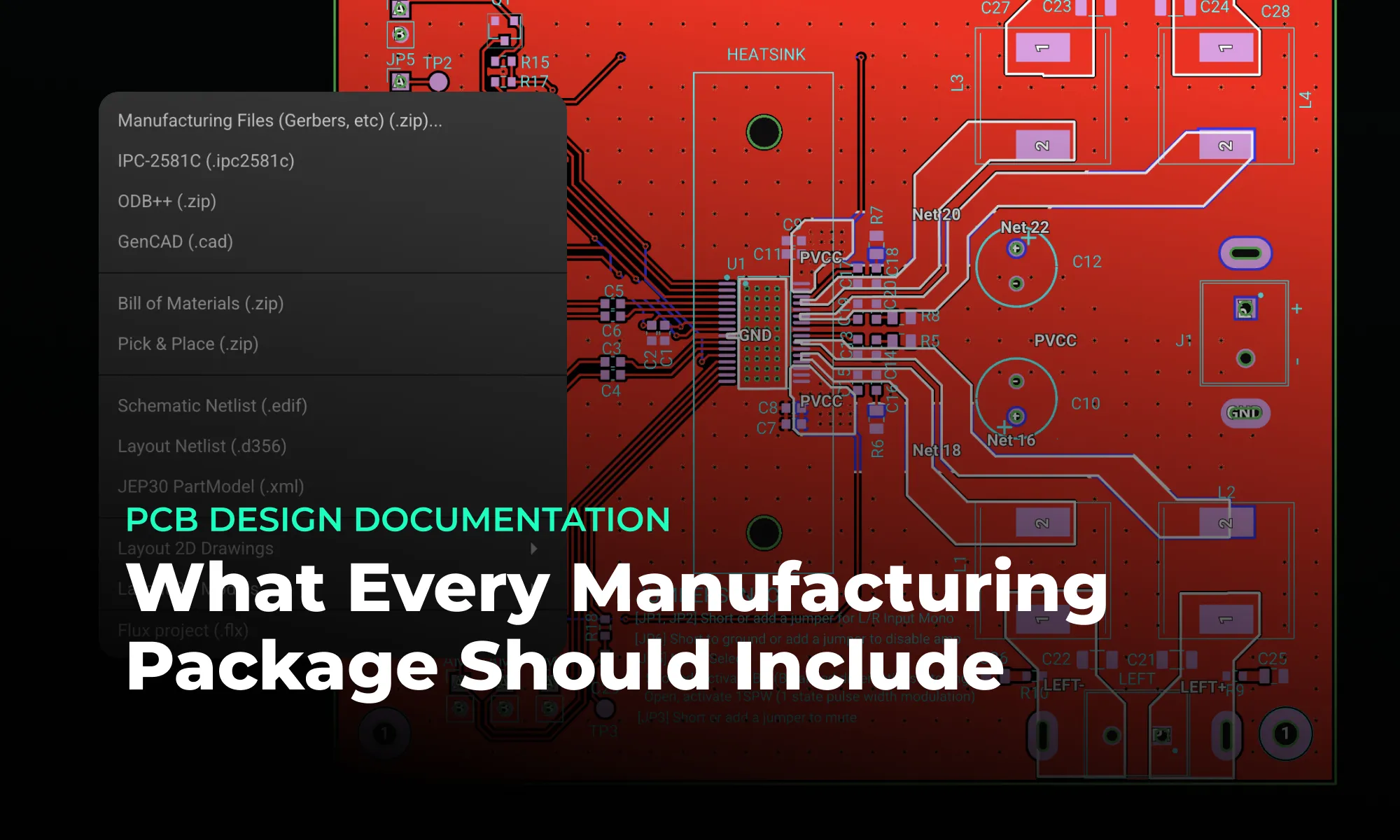
A checklist for PCB design documentation -- covering the files, drawings, and release data every manufacturing package should include.

A practical guide to PCB library management -- how hardware teams standardize components, centralize libraries, and scale collaborative design workflows.

An engineer-friendly explainer of PCB netlists -- what they contain, how they are generated, and how they connect schematic capture to PCB layout.

A practical guide to via stitching in PCB design -- what it is, why it improves EMI, signal integrity, and thermal performance, and where to place stitching vias. Includes spacing rules (like lambda/20), design guidelines, common mistakes to avoid, and how Flux can automate stitching via placement.

A guide to PCB component selection, covering electrical specs, footprints, thermal performance, sourcing, and best practices for picking parts that ship reliably.

A guide to PCB design reviews, covering schematic, layout, and DFM checks engineers use to catch errors early and ship more reliable boards.

A guide to creating and managing PCB footprint libraries, covering IPC standards, pad sizing, validation workflows, and best practices for reliable land patterns.


