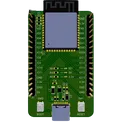
ESP32 Schematics
The ESP32 is a low-cost, low-power microcontroller with built-in Wi-Fi and Bluetooth capabilities. It is a highly integrated chip designed for the Internet of Things (IoT) and can be used for a variety of applications, including home automation, wearable technology, and industrial control. One of the key features of the ESP32 is its versatility and wide range of available peripherals, including sensors, displays, and communication modules. This makes it ideal for use in a variety of projects and applications, such as home security systems, smart home devices, and industrial automation systems. Flux.ai has the world's largest community-driven public library of ESP32 devices, with a range of footprints, symbols, datasheets, and simulation models available for users. This extensive library allows developers and designers to easily incorporate the ESP32 into their projects and take advantage of its powerful capabilities. Whether you are building a simple IoT device or a complex industrial control system, the ESP32 is an excellent choice due to its versatility and wide range of available resources.
ESPRSSO32 Smart Scale AI Auto Layout [Example]
Learn how to use AI Auto Layout on this ESP32 Espresso Smart Scale! In one click you’ll see AI Auto Layout perform magic. Pay close attention to how we recommend creating rulesets, zones, and fanouts. By copying the setup in this example on your own project, you’ll have a fully routed board in no time!
0 Uses0 StarsESP32 Robot Controller | AI Design Review Tutorial [Example]
Spot the mistake! Learn how to use AI to conduct a design review on an ESP32-based control board. This project is ideal for autonomous or radio-controller robots featuring inputs for sensors, encoders, and a Flysky RC receiver, plus an I2C display for configuration.
0 Uses0 StarsESP32-S2-MINI-2 Reference Design
This project is a reference design for an ESP32-S2-MINI-2 based device. It features USB-C for power and data transfer, onboard voltage regulation, and multiple peripheral connections. It also includes a CH340C for USB to serial conversion #referenceDesign #project #ESP32 #ESP32S2 #RF #WIFI #MCU #referenceDesign #simple-embedded #espressif #template
0 Uses0 StarsESPRSSO32 Smart Scale AI Auto Layout [Example]
Learn how to use AI Auto Layout on this ESP32 Espresso Smart Scale! In one click you’ll see AI Auto Layout perform magic. Pay close attention to how we recommend creating rulesets, zones, and fanouts. By copying the setup in this example on your own project, you’ll have a fully routed board in no time!
0 Uses0 StarsESP32 Robot Controller | AI Design Review Tutorial [Example]
Spot the mistake! Learn how to use AI to conduct a design review on an ESP32-based control board. This project is ideal for autonomous or radio-controller robots featuring inputs for sensors, encoders, and a Flysky RC receiver, plus an I2C display for configuration.
0 Uses0 StarsESP-CAM Motherboard Modules
This project is a motherboard for the ESP32-CAM module, which enables easy and flexible WiFi camera applications. The motherboard provides power supply, programming interface, and GPIO expansion for the ESP32-CAM. It also supports external sensors for more functionality. #motherboard #WiFi #MCU #ReferenceDesign #project #ESP32 #camera #reusable #module #edgeComputing #espressif #template
0 Uses0 StarsESP32-WROOM-32E Reference Design ePe2
This project is a reference design for an ESP32-WROOM-32E based device. It features USB-C for power and data transfer, onboard voltage regulation, and multiple peripheral connections. It also includes a CH340C for USB to serial conversion #referenceDesign #project #ESP32 #ESP32WROOM #RF #WIFI #MCU #referenceDesign #simple-embedded #espressif #template #reference-design
0 Uses0 StarsESPRSSO32 Smart Scale AI Auto Layout [Example]
Learn how to use AI Auto Layout on this ESP32 Espresso Smart Scale! In one click you’ll see AI Auto Layout perform magic. Pay close attention to how we recommend creating rulesets, zones, and fanouts. By copying the setup in this example on your own project, you’ll have a fully routed board in no time!
0 Uses0 StarsESPRSSO32 Smart Scale AI Auto Layout [Power Prompt Example]
Learn how to use AI Auto Layout on this ESP32 Espresso Smart Scale! In one click you’ll see AI Auto Layout perform magic. Pay close attention to how we recommend creating rulesets, zones, and fanouts. By copying the setup in this example on your own project, you’ll have a fully routed board in no time!
0 Uses0 StarsESPRSSO32 Smart Scale AI Auto Layout [Example] 1Hqt
Learn how to use AI Auto Layout on this ESP32 Espresso Smart Scale! In one click you’ll see AI Auto Layout perform magic. Pay close attention to how we recommend creating rulesets, zones, and fanouts. By copying the setup in this example on your own project, you’ll have a fully routed board in no time!
0 Uses0 StarsDominant Plum Speeder Bike
3.3V ESP32-S3 Dual 6V Rail MOSFET Board with MCP23017 I2C Expanders, Option C Gate Network, SW2 DPST Rail-Interlock, 2S LiFePO4 Charger/BMS (BQ24618 + BQ29209) with Series Battery Wiring and Charge Integration, and 2×10 RA Headers (#MCP23017_3V3 #OptionC #GateNetwork #RailInterlock #Dual6V #BQ24618 #BQ29209 #2S #LiFePO4 #SeriesBattery #ChargeIntegration #RAHeaders)
0 Uses0 StarsESP32 Robot Controller | AI Design Review Tutorial [Example]
Spot the mistake! Learn how to use AI to conduct a design review on an ESP32-based control board. This project is ideal for autonomous or radio-controller robots featuring inputs for sensors, encoders, and a Flysky RC receiver, plus an I2C display for configuration.
0 Uses0 StarsESP32-S3-WROOM-1 Reference Design
This project is a reference project for ESP32-S3-WROOM-1 to develop your IoT ideas. The board has 3 LEDs, USB C for firmware, EN and BOOT buttons, and 2 IO connectors for development #IoT #WiFi #MCU #RF #ESP32 #project #referenceDesign #simple-embedded #espressif #template #reference-design
0 Uses0 StarsESPRSSO32 Smart Scale AI Auto Layout [Example]
Learn how to use AI Auto Layout on this ESP32 Espresso Smart Scale! In one click you’ll see AI Auto Layout perform magic. Pay close attention to how we recommend creating rulesets, zones, and fanouts. By copying the setup in this example on your own project, you’ll have a fully routed board in no time!
0 Uses0 StarsArchitectural Lavender Translation Collar
Architectural Lavender Translation Collar – ESP32‑S3 Wi‑Fi + LoRa, USB‑C, Li‑ion, low‑power design Overview Experience a cutting-edge IoT solution with this low‑power board built around the ESP32‑S3‑MINI‑1‑N8. Designed for seamless Wi‑Fi (2.4 GHz), BLE, and LoRa (868 MHz) connectivity, this board integrates ENS161 and ENS210 sensors over I2C alongside an RFM95W‑868 LoRa radio on SPI. It is powered via a 3.7 V Li‑ion cell with USB‑C charging up to 500 mA, complete with full battery protection, a robust 3.3 V rail tailored for Wi‑Fi burst currents, and per‑peripheral power gating to enhance energy efficiency. Core Features • MCU: ESP32‑S3‑MINI‑1‑N8 equipped with an onboard PCB antenna for 2.4 GHz Wi‑Fi/BLE, ensuring optimal wireless performance. • Sensors: Integrated ENS161 and ENS210 sensors utilize a shared I2C bus with controllable 4.7 kΩ pull‑ups for streamlined communication. • LoRa Radio: The RFM95W‑868 module, connected via SPI, enables long‑range communication at 868 MHz. Power & USB‑C Connectivity • Battery: A reliable 3.7 V 1200 mAh Li‑ion battery connected via a right‑angle JST‑PH 2‑pin connector features built‑in battery protection. • Charging: The USB‑C receptacle, with CC resistors and TVS protection on D+/D− along with series resistors, supports fast, safe charging with a current limit of 500 mA. • Regulation: A dedicated 3.3 V regulator capable of handling Wi‑Fi burst currents coupled with bulk and high‑frequency decoupling ensures stable operation, supported by status LEDs indicating power and charge states. Low‑Power Control • Peripheral Management: Load switches allow selective power‑gating of the ENS161, ENS210, and RFM95W modules, controlled directly by ESP32‑S3 GPIOs. • Energy Efficiency: Controllable I2C pull‑ups minimize idle current, vital for prolonged battery life in IoT applications. RF and Antenna Integration • 2.4 GHz: Utilizes the integrated PCB antenna on the ESP32‑S3 with proper ground/metal keep‑out zones for optimal signal integrity. • 868 MHz: Features a controlled‑impedance feed from the RFM95W to a PI matching network (C‑L‑C pads) with flexible antenna options—selectable via SMA connector, chip antenna, or PCB trace—and includes RF ESD protection. Connectivity & Debug Features • USB‑C Interface: Provides secure data connectivity with integrated safeguards and proper terminations. • Debugging: A comprehensive programming/debug header exposes EN, BOOT, and UART lines, with test points on key rails and buses (3V3, VBAT, SCK, MOSI, MISO, SDA, SCL, RESET/EN, GND) to simplify development and troubleshooting. Design Verification • Rigorous ERC/DRC and decoupling checks ensure adherence to component ratings and optimal signal routing. • Maintain RF keep‑outs and impedance‑controlled traces for both 2.4 GHz and 868 MHz paths, securing reliable performance even during high‑intensity operations. #IoT #ESP32S3 #LoRa #LowPowerDesign #USB-C #WirelessConnectivity #BatteryPowered #RFDesign
0 Uses0 Stars