Relays
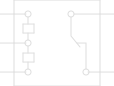
A relay is an electrically operated switch that allows a low power circuit to control a high power circuit. It consists of a coil, which is activated by an electric current, and a set of contacts that open or close when the coil is activated. Relays have a wide range of use cases, including controlling the flow of electricity in a circuit, protecting electrical components from damage, and amplifying signals. They are commonly used in automotive systems, HVAC systems, and control panels. Flux.ai has the world's largest community-driven public library of relays, with footprints, symbols, datasheets, and simulation models. This library is a valuable resource for engineers and designers looking for reliable and accurate information on relays.
2961299
REL-MR- 12DC/21-21AU - Plug-in miniature power relay, with multi-layer gold contact, 2 changeover contacts, input voltage 12 V DC General Purpose Relay DPDT (2 Form C) 12VDC Coil Through Hole The Phoenix Contact 2961299 (REL-MR-12DC/21-21AU) is a plug-in miniature power relay designed for reliable switching in industrial automation, control panels, and interface applications. It features a 12 VDC monostable coil, 2 changeover (DPDT) contacts, and hard gold-plated AgNi contacts, making it suitable for switching low-level signals with high reliability. The relay is RT III sealed (wash-proof), ensuring protection against contaminants during PCB cleaning and harsh industrial environments. It is intended for use with compatible Phoenix Contact relay bases and accessories. Key Features 12 VDC monostable coil operation 2 changeover (DPDT) contacts Hard gold-plated AgNi contacts for reliable low-level signal switching RT III sealed (wash-proof) construction Mechanical life: up to 30 million operations 5 kV coil-to-contact isolation Fast operate and release times (typ. 7 ms / 3 ms) Designed for industrial control, PLC interfaces, automation, and switching applications Compatible with Phoenix Contact relay sockets and interface modules #PhoenixContact #Relay #PowerRelay #DPDTRelay #IndustrialAutomation #ControlPanel #PLC #InterfaceRelay #12VDC #ElectromechanicalRelay
6 Uses0 StarsG6K-2F-Y DC5
Telecom Relay DPDT (2 Form C) Surface Mount The G6K-2F-Y DC5 specification defines the engineering requirements for a low-profile dual-pole signal relay designed for precision switching in electronic control and communication systems. This specification establishes the functional, electrical, mechanical, environmental, and quality requirements necessary to ensure reliable signal switching, low contact resistance, and long-term operational stability in compact electronic assemblies. The relay is intended for use in telecommunications equipment, instrumentation, industrial control systems, automated test equipment, and embedded electronic applications requiring high-reliability signal routing. It provides electrically isolated switching with low power consumption and stable contact performance, making it suitable for low-level signal and logic circuit applications. Engineering Requirements The relay shall be manufactured using qualified electromechanical components and controlled production processes to ensure consistent switching characteristics, mechanical durability, and long service life. The internal contact system shall provide reliable electrical continuity and repeatable switching performance throughout the specified operational life. Electrical characteristics shall ensure stable contact resistance, low coil power consumption, high insulation resistance, and reliable dielectric isolation between coil and contact circuits. The relay shall maintain dependable switching performance under specified voltage, current, temperature, and environmental operating conditions. Mechanical construction shall provide accurate contact alignment, secure enclosure integrity, and resistance to vibration, shock, and thermal cycling. The package shall be suitable for printed circuit board mounting and compatible with standard electronic assembly and soldering processes without degradation of performance. Workmanship shall be free from defects including contamination, corrosion, mechanical deformation, contact misalignment, or structural irregularities that could adversely affect electrical or mechanical reliability. Inspection, validation, and testing shall be conducted using calibrated equipment and controlled quality procedures to verify compliance with all applicable engineering and manufacturing requirements. Any deviation from this specification shall require formal engineering evaluation, documented technical justification, and approval through the established engineering change control process before implementation. Documentation Supporting documentation shall include engineering drawings, electrical performance specifications, qualification reports, inspection records, material declarations, and revision-controlled manufacturing documentation. All documentation shall be maintained under formal configuration management and quality assurance systems to ensure complete product traceability. Revision Control Any modification to this specification shall be managed through the formal engineering change management process. All revisions shall undergo technical review, validation, and approval before release to ensure continued compliance with design intent and applicable engineering standards. #EngineeringSpecification #SignalRelay #ElectromechanicalRelay #ElectronicSwitching #IndustrialElectronics #EmbeddedSystems #Telecommunications #QualityAssurance #EngineeringDocumentation #ElectronicComponents
60 Uses0 Stars