Relays
A relay is an electrically operated switch that allows a low power circuit to control a high power circuit. It consists of a coil, which is activated by an electric current, and a set of contacts that open or close when the coil is activated. Relays have a wide range of use cases, including controlling the flow of electricity in a circuit, protecting electrical components from damage, and amplifying signals. They are commonly used in automotive systems, HVAC systems, and control panels. Flux.ai has the world's largest community-driven public library of relays, with footprints, symbols, datasheets, and simulation models. This library is a valuable resource for engineers and designers looking for reliable and accurate information on relays.
G5V-2-DC5
General Purpose Relay DPDT (2 Form C) Through Hole The G5V-2-DC5 is a compact signal relay manufactured by Omron Electronic Components and designed for reliable low-power switching in telecommunications, industrial control systems, instrumentation, automation equipment, security systems, and embedded electronic applications. The relay utilizes a dual-pole double-throw contact arrangement, enabling flexible signal routing and isolation between control and load circuits. The device features a highly reliable electromagnetic switching mechanism optimized for stable operation, low contact resistance, and consistent electrical performance throughout its service life. Its compact package allows efficient PCB integration while supporting high-density circuit layouts. The relay is engineered to provide dependable switching of low-level signals and control circuits where accuracy, durability, and long-term reliability are critical design requirements. The construction incorporates high-quality contact materials and precision mechanical components to ensure excellent switching characteristics, enhanced contact stability, and resistance to environmental influences. The relay is suitable for applications requiring galvanic isolation, signal multiplexing, interface switching, and control circuit management. General Description The G5V-2-DC5 is a miniature signal relay intended for precision switching applications in electronic systems. It offers dependable electrical isolation between circuits while maintaining excellent signal integrity and operational reliability. Its compact footprint, proven switching performance, and robust construction make it a popular choice for communication equipment, industrial electronics, measurement systems, network infrastructure, security devices, and embedded control platforms. The relay is widely recognized for its reliability, ease of integration, and suitability for demanding electronic switching environments. #G5V2DC5 #Omron #SignalRelay #ElectromechanicalRelay #PCBRelay #IndustrialElectronics #EmbeddedSystems #Automation #ControlSystems #Telecommunications #ElectronicComponents #HardwareDesign #CircuitProtection #ElectricalEngineering #PCBDesign #RelayModule #ElectronicSwitching #Instrumentation #EngineeringSpecification #ElectronicsDesign
22 Uses0 StarsCPDT-12V
The CPDT-12V is an electromechanical relay designed for switching and control applications in industrial, automotive, consumer, and embedded electronic systems. Operating from a nominal twelve-volt coil supply, this relay provides reliable isolation between low-power control circuitry and higher-power loads. Its compact construction, robust contact mechanism, and dependable switching performance make it suitable for power distribution, automation controls, battery-powered equipment, protection circuits, and general-purpose switching applications. The relay incorporates a magnetic coil and mechanical contact assembly that enables safe control of AC or DC loads while maintaining electrical isolation between the control and load sides. Its durable design supports repeated switching operations and long service life in demanding environments. Features Electromechanical relay with nominal twelve-volt coil operation Provides galvanic isolation between control and load circuits Suitable for AC and DC load switching Reliable contact performance for power and signal applications Compact package for PCB mounting Low control power requirement Durable contact system for long operational life Fast switching response characteristics Compatible with industrial and embedded control systems Designed for automation, protection, and power management circuits Applications Industrial automation equipment Power control modules Battery-powered systems Automotive electronics Home appliance control circuits Smart energy management devices Security and alarm systems Embedded controller interfaces Motor and actuator switching General-purpose load control applications Electrical Characteristics Nominal coil voltage: twelve volts DC Electromagnetic actuation mechanism Isolated contact structure Designed for low-voltage control interfaces Supports switching of resistive and inductive loads Stable operation across specified environmental conditions Mechanical Characteristics PCB-mount relay construction Compact footprint for space-constrained designs Durable housing for electrical and mechanical protection Secure terminal arrangement for reliable soldering and connection Engineered for repeated switching cycles Environmental Characteristics Suitable for indoor industrial and commercial environments Resistant to normal operating vibration and mechanical shock conditions Designed for reliable operation across standard electronic equipment temperature ranges #commonpartslibrary #relay #electromechanicalrelay #switchingdevice #powermanagement #industrialautomation #controlsystems #pcbmount #automationelectronics #circuitprotection #embeddedsystems #industrialelectronics
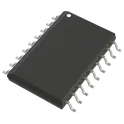
55 Uses0 StarsULN2803ADW
Bipolar (BJT) Transistor Array 8 NPN Darlington 50V 500mA Surface Mount 18-SOIC The ULN2803ADW is a high-voltage, high-current Darlington transistor array designed for interfacing low-level digital logic circuits with high-power loads. The device integrates eight NPN Darlington pairs with common-emitter outputs and suppression diodes for inductive load driving. It is commonly used in relay drivers, LED matrix control, solenoid actuation, motor drivers, lamp control, and industrial automation interfaces. The integrated clamp diodes enable direct driving of inductive loads without requiring additional external protection circuitry. The input stage is compatible with standard TTL and CMOS logic levels, making the device suitable for microcontroller, FPGA, and processor-based systems. The ULN2803ADW provides compact multi-channel switching capability in a wide-body SOIC surface-mount package optimized for automated assembly and high-density PCB layouts. Key Features Eight-channel NPN Darlington transistor array High-current sink driver outputs Integrated flyback suppression diodes TTL and CMOS compatible inputs Open-collector outputs Suitable for inductive and resistive loads High output voltage capability Parallel output operation supported for increased current handling Wide operating voltage range Surface-mount SOIC wide-body package Industrial and embedded control application support Electrical Characteristics Darlington transistor output configuration High DC current gain Low input current requirement Common-cathode clamp diode structure Open-collector output topology Logic-level input compatibility High-voltage output tolerance Multi-channel simultaneous switching support Applications Relay and solenoid drivers Stepper motor interfaces LED and lamp driving Industrial automation systems PLC output stages Embedded control systems Printer and actuator control Automotive electronics Logic buffer and level shifting applications Package Information Package Type: SOIC Wide Body Mounting Type: Surface Mount Multi-pin integrated driver package RoHS compliant options available #commonpartslibrary #integratedcircuit #driveric #darlingtonarray #powermanagement #industrialelectronics #embeddedhardware #relaydriver #motorcontrol #automationelectronics
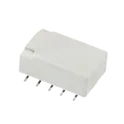
82 Uses0 StarsTQ2SA-L2-3V-Z
Flat, 5 mm 2 Form C, 2 A, relays Telecom Relay DPDT (2 Form C) Surface Mount The TQ2SA-L2-3V-Z is a compact surface-mount DPDT (2 Form C) telecom/signal relay from Panasonic Industry designed for low-power switching applications. It features a dual-coil latching mechanism, allowing the relay to maintain its state without continuous coil power, making it suitable for battery-powered and energy-efficient systems. This relay is commonly used in telecommunications equipment, industrial controls, measurement devices, and embedded electronic systems. Key Features DPDT (2 Form C) contact configuration 3V DC dual-coil latching relay Low power consumption: approximately 140 mW Compact SMD package: only 5.6 mm height Surface-mount gull-wing terminals Sealed construction for automatic washing compatibility High switching capability: up to 2 A Wide switching voltage range: up to 125 VAC / 220 VDC Fast operate/release time: approx. 4 ms High dielectric strength and surge resistance Wide operating temperature: −40°C to +85°C Gold-clad AgNi contacts for reliable low-level signal switching Tape-and-reel packaging (“Z” suffix) for automated assembly #CommonPartsLibrary #relay
4 Uses0 StarsLM393N
Comparator Standard (General Purpose) Open-Collector, Rail-to-Rail 8-PDIP The LM393N is a dual independent voltage comparator designed for operation from a single power supply over a wide range of voltages. It can also operate from split power supplies, allowing flexible integration into analog and mixed-signal systems. Each comparator features high gain and low input offset voltage, enabling precise comparison between two input signals. The device is optimized for low power consumption and supports open-collector outputs, making it suitable for interfacing with a variety of logic families and external circuits. Its robust design allows reliable performance across a broad temperature range, making it appropriate for industrial, automotive, and consumer applications. Functional Overview The device contains two separate comparators sharing a common power supply. Each comparator compares the voltage at its inverting and non-inverting inputs and drives the output transistor accordingly. The open-collector output stage allows wired-OR configurations and easy level shifting using an external pull-up resistor. When the non-inverting input voltage exceeds the inverting input voltage, the output transistor turns off, allowing the output to be pulled high externally. When the inverting input is higher, the transistor conducts and pulls the output low. Electrical Characteristics The LM393N operates over a wide supply voltage range and exhibits low input bias current and low input offset voltage, contributing to stable and accurate performance. The input common-mode voltage range includes ground, enabling ground-referenced sensing. The output stage is capable of sinking current sufficient to drive loads such as LEDs, relays (with appropriate buffering), or logic inputs. The device is designed for low supply current, supporting energy-efficient designs. Input and Output Behavior Inputs are high impedance and suitable for direct connection to sensors, reference voltages, or signal conditioning networks. The output requires an external pull-up resistor to define the high logic level. This configuration allows flexibility in selecting output voltage levels independent of the supply voltage, within device limits. The open-collector structure also supports multiple outputs connected together for logical operations. Thermal and Environmental Conditions The device is specified for operation across a wide temperature range, ensuring stable functionality under varying environmental conditions. Proper thermal management and adherence to recommended operating conditions ensure long-term reliability. Packaging and Pin Configuration The LM393N is typically provided in a dual in-line package suitable for through-hole mounting. The pin configuration supports two independent comparator channels, each with inverting input, non-inverting input, and output, along with shared power supply and ground connections. Applications The LM393N is suitable for voltage level detection, threshold sensing, zero-crossing detection, oscillator circuits, pulse generation, and analog-to-digital interfacing. It is commonly used in power management systems, battery monitoring, signal conditioning, and embedded control systems. Design Considerations External components such as pull-up resistors, input filtering networks, and hysteresis feedback may be required depending on the application. Careful layout and noise considerations improve performance in high-sensitivity circuits. The open-collector output requires proper configuration to ensure correct logic levels and switching behavior. #commonpartslibrary #integratedcircuit #comparator
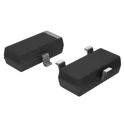
29 Uses0 StarsMMBT2222ALT3G
Bipolar (BJT) Transistor NPN 40V 600 mA 300MHz 300 mW Surface Mount SOT-23-3 (TO-236) The MMBT2222ALT3G is a NPN general-purpose bipolar junction transistor (BJT) manufactured by onsemi, designed in a SOT-23 surface-mount package. It is the SMD version of the well-known 2N2222A transistor family, used for switching and signal amplification in compact electronic circuits. It is widely used in industrial, automotive (AEC-Q101 qualified variants), and general embedded systems due to its reliability, small size, and good electrical performance. Key Features NPN General-Purpose Transistor Suitable for switching and low-power amplification Collector-Emitter Voltage (Vceo) Up to 40 V Collector Current Up to 600 mA Power Dissipation Around 225–300 mW (depending on package conditions) High Frequency Performance Transition frequency up to ~300 MHz DC Current Gain (hFE) Typically ~100 at moderate currents Low Saturation Voltage Efficient switching performance for digital circuits SOT-23 Surface-Mount Package Compact footprint for modern PCB designs Wide Temperature Range Typically -55°C to +150°C RoHS / Lead-Free Compliant Environmentally compliant manufacturing Typical Applications LED switching circuits Relay driver stages MCU signal interfacing (Arduino, ESP32, etc.) Small motor drivers General signal amplification Automotive and industrial control circuits Important Note MMBT2222ALT3G = SMD version (SOT-23) Equivalent to 2N2222A (TO-92 through-hole version) in function, but not in physical package. 2N2222A SOT-23 #commonpartslibrary #transistor #bjt
683 Uses0 StarsHF49FD/005-1H11TF
Hongfa Europe GMBH PCB Mount Power Relay, 5V dc Coil, 5A Switching Current, SPS The HF49FD/005-1H11TF is part of the Hongfa HF49FD series, which consists of compact, high-sensitivity power relays. It operates using a 5 V DC coil and provides electrical isolation between the control circuit and the load, allowing low-power signals (e.g., from a microcontroller) to switch higher voltages or currents. Key Characteristics Type: Electromagnetic relay (non-latching) Contact Configuration: SPST-NO (1 Form A, normally open) Coil Voltage: 5 V DC Switching Current: up to 5 A Switching Voltage: 250 VAC 30 VDC Mounting Type: Through-hole / PCB mount Size: ~20 × 5 × 12.5 mm (slim design) Coil Power Consumption: ~120 mW (low power) Dielectric Strength: up to 3 kV isolation Functional Overview Uses a coil + mechanical contacts: When 5 V is applied → coil energizes → contacts close When removed → contacts open Provides electrical isolation between: control side (low voltage) load side (higher voltage/current) #Relay
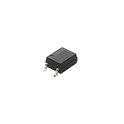
36 Uses0 StarsG3VM-61VY3(TR05)
Solid State Photo-Coupled Relay (Photorelay) SPST-NO (1 Form A) 4-SOP (0.179", 4.55mm) The G3VM-61VY3(TR05) is a single-pole, single-throw normally open (SPST-NO) solid-state relay that uses an LED input and MOSFET output to switch AC or DC loads without mechanical contacts. It provides fast, silent, and highly reliable switching in a very small surface-mount package. Key Characteristics Relay Type: Solid State Relay (Photorelay) Contact Form: SPST-NO (1 Form A) Output Type: MOSFET Load Voltage: Up to 60 V AC/DC Load Current: Up to 700 mA On-Resistance: ~2 Ω max Input Control: LED-driven (low current DC input) Isolation Voltage: ~3.75 kV (input to output) Package: SOP-4 surface-mount (compact form factor) Packaging Option: TR = Tape & Reel for automated assembly How It Works The input LED is energized with a small DC current. It activates an internal photo-coupler. This drives a pair of MOSFETs, turning the load ON or OFF. No mechanical movement → no arcing or contact wear. Key Advantages Silent operation (no clicking sound) Very long life (no mechanical parts) Fast switching speed Compact size for dense PCB layouts Low leakage and stable performance Typical Applications Semiconductor test equipment Industrial control systems Battery-powered devices Data acquisition systems Communication and measurement circuits General-purpose signal switching #CommonPartsLibrary #Relay #SSR #G3VM
189 Uses0 Stars