Arduino Projects
Arduino is an open-source electronics platform based on easy-to-use hardware and software. It is designed for anyone to use, regardless of their level of expertise in electronics. Arduino boards are commonly used for a wide range of projects, including building DIY devices, controlling home appliances, creating interactive art installations, and more. One of the key benefits of Arduino is its community-driven nature. There are a plethora of resources available online for those looking to learn more about Arduino or troubleshoot problems they may encounter while working on a project. Flux.ai has the world's largest community-driven public library of Arduino footprints, symbols, datasheets, and simulation models. This makes it an invaluable resource for those looking to take their Arduino projects to the next level. Whether you're a beginner or a seasoned pro, Flux.ai has something to offer.
2.54-1*4P母
CONN SOCKET 4POS 2.54mm SINGLE ROW TH This connector consists of a single row of 4 electrical pins spaced 2.54 mm apart. It is typically available as a male pin header, female header, or wafer connector depending on the application. The part is commonly used for power, signal, UART, GPIO, sensor, and programming connections in embedded systems and prototyping. Key Features 2.54 mm pitch spacing Industry-standard spacing compatible with breadboards and jumper wires 1x4 configuration Single row with 4 contacts/pins Compact PCB connection solution Suitable for board-to-board or wire-to-board applications Easy solder mounting Typically through-hole (THT), though SMT variants may exist Wide compatibility Works with Arduino, Raspberry Pi modules, sensors, and development boards Durable metal contacts Usually tin- or gold-plated for reliable electrical connection Multiple orientations available Straight vertical or right-angle versions Low-cost and widely available Commonly used in consumer electronics and DIY projects Common Applications GPIO and sensor connections UART / serial interfaces Power input/output headers Embedded system prototyping Module interconnections Debug and programming interfaces #CommonPartsLibrary #Connector
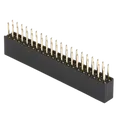
1.0k Uses1 Stars2.54-2*20
Female Headers CONN SOCKET 40POS 2.54mm DUAL ROW TH This connector consists of 40 pins total (2 rows × 20 pins) spaced at 2.54 mm pitch. It is widely used in PCB interconnections, embedded systems, Raspberry Pi-style GPIO headers, Arduino expansion boards, and general prototyping applications. It mates with standard female headers or jumper wires. Key Features Pin configuration: 2×20 (40 pins total) Pitch: 2.54 mm (0.1 inch standard) Mounting type: Through-hole (THT) Orientation options: Vertical or right-angle variants Contact material: Typically brass or phosphor bronze Plating: Tin or gold-plated options for improved conductivity Current rating: Commonly 1A–3A per pin (depends on manufacturer) Voltage rating: Typically up to 250V AC/DC (application-dependent) Compatibility: Standard 2.54 mm female headers and jumper cables Use cases: Development boards, GPIO expansion, debugging interfaces, mezzanine connections #CommonPartsLibrary #Connector
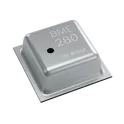
349 Uses1 StarsBME280
Humidity, Pressure, Temperature 0 ~ 100% RH I²C, SPI ±3% 1 s Surface Mount BME280 I2C breakout module The BME280 integrates three sensors—temperature, relative humidity, and pressure—along with a high-performance digital interface. It communicates via I²C or SPI, making it easy to interface with microcontrollers like Arduino, ESP32, and STM32. It is designed for low power consumption, making it suitable for battery-powered applications such as portable weather stations and smart home devices. Key Features Environmental Sensing Measures: Temperature Relative Humidity Barometric Pressure Enables altitude estimation based on pressure readings High Accuracy Temperature: ±1.0°C (typical) Humidity: ±3% RH (typical) Pressure: ±1 hPa (typical) Low Power Consumption Typical current: ~0.6 µA (sleep mode) ~3.6 µA (measurement mode) Ideal for battery-operated devices Communication Interfaces Supports: I²C (up to 3.4 MHz) SPI (3-wire / 4-wire) Easy integration with most microcontrollers Compact Package Small footprint: 2.5 × 2.5 × 0.93 mm LGA package Suitable for space-constrained designs Built-in Features Factory-calibrated coefficients stored in NVM Configurable oversampling and filtering Integrated ADC for high-resolution measurements #commonpartslibrary #sensor #humidity #pressure
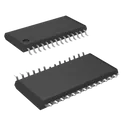
330 Uses1 StarsPCA9685PW,118
LED Driver IC 16 Output Linear PWM Dimming 25mA 5.5V 28-TSSOP PCA9685PW,118 is a 16-channel, 12-bit PWM LED controller with an I²C interface designed for LED dimming, RGB/RGBA lighting, and servo motor control applications. It provides independent PWM control for up to 16 outputs, allowing precise brightness or position control while minimizing MCU GPIO usage. The device supports Fast-mode Plus I²C communication up to 1 MHz and operates from a 2.3 V to 5.5 V supply range. It is commonly used in robotics, LED backlighting, automation systems, and PWM expansion modules for microcontrollers such as Arduino, ESP32, and Raspberry Pi. Key Features 16 independent PWM output channels 12-bit PWM resolution (4096 steps) Programmable PWM frequency from approximately 24 Hz to 1526 Hz I²C Fast-mode Plus compatible interface up to 1 MHz Six hardware address pins allowing up to 62 devices on one I²C bus Programmable open-drain or totem-pole outputs Output capability: 25 mA sink current 10 mA source current Internal 25 MHz oscillator with optional external clock input Individual programmable LED ON/OFF timing for reduced EMI and current surges Supports software reset and group addressing (All Call/Sub Call) 5.5 V tolerant inputs and outputs Operating voltage range: 2.3 V to 5.5 V Package: 28-pin TSSOP (PW suffix) #CommonPartsLibrary #IntegratedCircuit #PowerManagement #LEDdriver
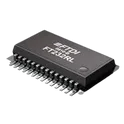
91 Uses1 StarsFT232RL
USB to Serial Interface, SSOP-28 FTDI USB Serial SSOP*5.3x10.2mm*P0.65mm* The FT232RL is a full-speed USB 2.0 to asynchronous serial data transfer IC. It integrates all the necessary USB protocol handling and UART interface logic, making it very easy to add USB connectivity to embedded devices without requiring complex firmware development. It is commonly used in development boards (like Arduino clones), USB-to-TTL converters, and debugging interfaces. Key Features USB Interface Fully compliant with USB 2.0 Full-Speed (12 Mbps) Integrated USB transceiver (no external components required) Supports USB suspend/resume modes Internal EEPROM for storing USB descriptors (no external EEPROM needed) Serial (UART) Interface Supports standard UART communication (TX, RX) Configurable baud rates from 300 bps up to 3 Mbps Supports hardware flow control (RTS/CTS, DTR/DSR) Bit-bang mode for simple GPIO control Integrated Components Built-in clock generator (no external crystal required) Internal EEPROM for configuration Integrated voltage regulator (3.3V output available for external use) Power Features Operates from 3.3V to 5V Can be powered directly from USB (bus-powered) Low power consumption with sleep mode Driver Support Virtual COM Port (VCP) drivers available for: Windows Linux macOS Also supports direct D2XX driver for advanced applications Package Typically available in SSOP-28 package Common Applications USB-to-serial converters (TTL/RS232) Microcontroller programming and debugging Embedded system communication Industrial and instrumentation interfaces
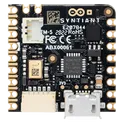
157 Uses1 StarsArduino Nicla Voice
The Arduino Nicla Voice packs machine-learning capabilities on the edge into a tiny fingerprint. Implement always-on speech recognition with the Nicla Voice. The board integrates a dedicated Neural Decision Processor Syntiant NDP 120 able to run multiple AI algorithms at the same time. Leverage the built-in microphone, nRF52832 microcontroller, Bluetooth Low Energy module, 6-axis IMU and 3-axis magnetometer to create your own wireless sensor network for machine learning applications with low power consumption capabilities.
9 Uses1 Stars