Microcontrollers
A microcontroller is a small, low-cost computer-on-a-chip that can be used to control electronic devices and systems. It consists of a central processing unit (CPU), memory, input/output (I/O) ports, and other peripherals integrated onto a single chip. Microcontrollers are commonly used in a wide range of applications, including automotive systems, home appliances, industrial automation, and consumer electronics. One of the key benefits of microcontrollers is their ability to interact with their environment through sensors and actuators, making them well-suited for use in embedded systems. These systems are often found in devices that require real-time control or data processing, such as medical equipment, aircraft, and factory automation systems. Flux.ai is home to the world's largest community-driven public library of microcontrollers, with footprints, symbols, datasheets, and simulation models for a wide range of devices. Whether you're a professional engineer looking for a specific microcontroller for your next project, or a hobbyist exploring the possibilities of microcontroller-based systems, Flux.ai has the resources you need to get started.
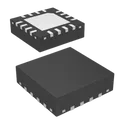
ADXL335BCPZ
Accelerometer X, Y, Z Axis ±3g 1.6kHz (X,Y), 550Hz (Z) 16-LFCSP-LQ (4x4) The ADXL335BCPZ is a small, thin, low-power, complete 3-axis accelerometer with signal-conditioned voltage outputs. It measures acceleration with a minimum full-scale range of ±3 g. The device outputs analog voltages proportional to acceleration in each of the three orthogonal axes (X, Y, and Z). The accelerometer is designed for low power consumption and high resolution, making it suitable for mobile devices, tilt sensing, motion detection, and vibration monitoring. It operates over a wide temperature range and requires minimal external components, enabling easy integration into compact systems. Functional Overview The ADXL335 uses a capacitive sensing structure to detect acceleration. Changes in acceleration result in differential capacitance changes, which are converted into voltage outputs through an internal signal conditioning circuit. Each axis provides an independent analog output that can be directly interfaced with ADC inputs of microcontrollers or other processing units. Bandwidth for each axis can be adjusted using external capacitors, allowing flexibility depending on application requirements. Electrical Characteristics Supply Voltage Range: 1.8 V to 3.6 V Supply Current: Typical: 350 µA Measurement Range: ±3 g Sensitivity (Typical): 300 mV/g Zero-g Bias Level: Approximately mid-supply voltage Bandwidth: User-selectable via external capacitors Typical range: X, Y axes: up to 1600 Hz Z axis: up to 550 Hz Output Characteristics Output Type: Analog voltage (ratiometric to supply voltage) Number of Axes: Three (X, Y, Z) Output Noise: Low noise suitable for precision motion sensing Cross-Axis Sensitivity: Typically ±1% Mechanical Characteristics Package Type: 16-lead LFCSP (Lead Frame Chip Scale Package) Dimensions: Approximately 4 mm × 4 mm × 1.45 mm Mounting: Surface mount Environmental Specifications Operating Temperature Range: −40°C to +85°C Shock Survivability: Up to 10,000 g Interface Requirements External Components: Requires capacitors for bandwidth setting (one per axis) Output Interface: Direct analog output compatible with ADC inputs Applications Mobile devices and handheld electronics Tilt and orientation sensing Vibration monitoring systems Gaming and motion input devices Industrial instrumentation Wearable electronics Key Features Low power consumption Compact form factor High resolution analog outputs User-adjustable bandwidth Wide operating temperature range Simple integration with minimal external components #commonpartslibrary #sensor #transducer #motionsensor #accelerometer
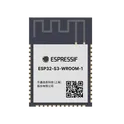
58 Uses1 StarsESP32-S3-WROOM-2-N32R16V
Bluetooth, WiFi 802.11b/g/n, Bluetooth v5.0 Transceiver Module 2.4GHz PCB Trace Surface Mount The ESP32-S3-WROOM-2-N32R16V is a powerful dual-core microcontroller module that integrates wireless connectivity, large memory, and hardware acceleration for AI and signal processing tasks. It is particularly suited for applications requiring edge AI, voice recognition, and high-speed data processing, while still maintaining low power consumption. Dual-core Xtensa LX7 CPU Up to 240 MHz Includes vector instructions for AI and DSP workloads Wi-Fi 2.4 GHz (802.11 b/g/n) Bluetooth 5 (LE) N32 → 32 MB external Flash R16 → 16 MB PSRAM Built for memory-intensive applications #commonpartslibrary #transceiver #wireless #rf
155 Uses1 StarsT-Display S3 AMOLED Plus
The T-Display S3 AMOLED Plus is a compact development board built around the ESP32-S3R8 microcontroller and features an integrated high-quality 1.91-inch AMOLED display with touch support. It’s designed to give you a ready-made visual interface and connectivity for advanced projects without needing a separate display shield.
18 Uses1 Stars