Microcontrollers
A microcontroller is a small, low-cost computer-on-a-chip that can be used to control electronic devices and systems. It consists of a central processing unit (CPU), memory, input/output (I/O) ports, and other peripherals integrated onto a single chip. Microcontrollers are commonly used in a wide range of applications, including automotive systems, home appliances, industrial automation, and consumer electronics. One of the key benefits of microcontrollers is their ability to interact with their environment through sensors and actuators, making them well-suited for use in embedded systems. These systems are often found in devices that require real-time control or data processing, such as medical equipment, aircraft, and factory automation systems. Flux.ai is home to the world's largest community-driven public library of microcontrollers, with footprints, symbols, datasheets, and simulation models for a wide range of devices. Whether you're a professional engineer looking for a specific microcontroller for your next project, or a hobbyist exploring the possibilities of microcontroller-based systems, Flux.ai has the resources you need to get started.
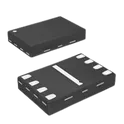
TPS3808G33DRVT
Monitors & Reset Circuits TPS3808G33DRVT WSON-6_L2.0-W2.0-P0.65-TL-EP LCSC Part Number: C702176 JLCPCB Part Class: undefined Manufactured by TI(德州仪器) Texas Instruments TPS3808 low-quiescent-current voltage supervisor and reset generator, supply voltage monitoring from 0.4V to 5V, 0.5% threshold accuracy, adjustable reset delay from 1.25ms to 10s using external capacitor, open-drain RESET output, manual reset (MR) input, ultra-low 2.4µA typical quiescent current, suitable for microcontrollers, DSPs, FPGAs, ASICs, battery-powered and portable devices, operating temperature range -40°C to +125°C, available in SOT-23-6 and WSON-6 packages. Search Keywords: TPS3808, TPS3808G, Texas Instruments TPS3808, TI TPS3808, voltage supervisor, reset supervisor, reset generator, watchdog reset, power-on reset, POR supervisor, brownout detector, voltage monitor IC, microcontroller supervisor, open drain reset, adjustable reset delay, manual reset supervisor, low power supervisor, battery powered reset IC, TPS3808 datasheet, TPS3808 SOT-23-6, TPS3808 WSON-6 Hashtags: #TPS3808 #TexasInstrumentsTPS3808 #TIVoltageSupervisor #VoltageSupervisor #ResetSupervisor #ResetGenerator #PowerOnReset #BrownoutDetector #VoltageMonitorIC #MicrocontrollerSupervisor #OpenDrainReset #ManualReset #LowPowerSupervisor #BatteryPoweredDesign #SOT236 #WSON6
57 Uses0 StarsW25Q16JVUXIQ
SPI Flash Serial Flash Memory with Dual/Quad SPI The W25Q16JVUXIQ is a 16-Mbit (2-MByte) Serial NOR Flash memory device from Winbond. It is designed for embedded systems that require non-volatile code and data storage with minimal pin count, low power consumption, and high-speed access. The device supports standard SPI, Dual SPI, and Quad SPI interfaces, making it suitable for firmware storage, boot memory, IoT devices, microcontrollers, consumer electronics, and execute-in-place (XIP) applications. Key Features 16-Mbit (2-MByte) Flash Memory Capacity Operating Voltage: 2.7 V to 3.6 V Standard SPI, Dual SPI, and Quad SPI Interface Support Maximum SPI Clock Frequency: 133 MHz Equivalent Data Transfer Rates: 266 MHz (Dual SPI) 532 MHz (Quad SPI) Continuous Read and XIP (Execute-In-Place) Capability 4 KB Sector Erase, 32 KB Block Erase, 64 KB Block Erase, and Chip Erase 256-Byte Programmable Page Size Minimum 100,000 Program/Erase Cycles per Sector More Than 20 Years Data Retention Ultra-Low Power Consumption Typical power-down current below 1 µA 64-Bit Unique Serial Number Three 256-Byte Security Registers with OTP Protection JEDEC ID and SFDP Support Software and Hardware Write Protection Operating Temperature Options up to +85°C and +105°C Compact 8-Pad USON Package (2 mm × 3 mm) suitable for space-constrained designs #CommonPartsLibrary #IntegratedCircuit #Memory
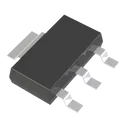
242 Uses0 StarsAMS1117-3.3RG
The AMS1117-3.3RG is a fixed-output, low-dropout (LDO) linear voltage regulator that provides a regulated 3.3 V output from a higher input voltage. It is capable of delivering up to 1 A output current and is commonly used in microcontroller, communication, and embedded-system power supplies where a stable 3.3 V rail is required. The device includes built-in protection features such as current limiting and thermal shutdown for improved reliability. Key Features Fixed 3.3 V output voltage Supports up to 1 A output current Low dropout voltage, typically around 1.2 V and up to 1.3 V at 1 A load Input voltage capability up to 12 V (some manufacturer variants specify higher absolute maximum ratings) Good line and load regulation Built-in current limiting protection Built-in thermal shutdown protection Available in SOT-223 surface-mount package Suitable for post-regulation of switching power supplies and general 3.3 V power conversion applications Typical Applications ESP32, STM32, and other microcontroller-based systems Embedded and IoT devices Communication modules LCD monitors and display circuits Battery-powered equipment Post-regulation for DC/DC converters Motherboards and expansion cards #CommonPartsLibrary #IntegratedCircuit #PowerManagement #LDO
140 Uses0 StarsLAN8720A-CP-TR-ABC
Small Footprint RMII 10/100 Ethernet Transceiver with HP Auto-MDIX Support LAN8720A-CP-TR-ABC is a low-power, single-port 10BASE-T/100BASE-TX Ethernet Physical Layer (PHY) transceiver from Microchip Technology. It is designed to connect a microcontroller, processor, or Ethernet MAC to a standard Ethernet network through an RMII (Reduced Media Independent Interface). The device is widely used in embedded networking applications such as industrial controllers, IoT gateways, IP cameras, networked printers, routers, and ESP32-based Ethernet designs. Key Features Single-chip 10/100 Mbps Ethernet PHY Supports both 10BASE-T and 100BASE-TX Ethernet operation. RMII Interface Reduced pin-count interface for easy connection to Ethernet MACs and microcontrollers. IEEE 802.3 / 802.3u Compliant Fully compliant with Fast Ethernet standards. HP Auto-MDIX Support Automatically detects and configures straight-through or crossover Ethernet cables. Auto-Negotiation Automatically selects the best available speed and duplex mode. Flexible I/O Voltage Supports LVCMOS I/O voltages from 1.6 V to 3.6 V, simplifying interfacing with different processors. Integrated 1.2 V Regulator Allows operation from a single 3.3 V supply, reducing external components. Low-Power Architecture Features multiple power-saving modes through Microchip's flexPWR® technology. Built-in Diagnostics and Reliability Features Loopback modes, automatic polarity correction, link-status monitoring, and wake-up detection. Compact Package Available in a 24-pin SQFN/QFN (4 mm × 4 mm) package for space-constrained designs #CommonPartsLibrary #IntegratedCircuit
113 Uses0 Stars2.54-2*4P立贴针
CONN HEADER 8POS 2.54mm DUAL ROW SMD The 2.54-2×4P is a generic 8-pin dual-row connector/header with a 2.54 mm (0.1 inch) pitch, commonly used for board-to-board, wire-to-board, and programming/debug interfaces in electronic circuits. The designation 2×4P indicates two rows of four pins, providing a total of eight electrical connections in a compact arrangement. This type of connector is widely used in embedded systems, development boards, industrial control equipment, consumer electronics, and prototyping applications due to its standard pitch and broad compatibility with jumper wires, IDC cables, and mating sockets. Key Features 2.54 mm standard pitch (0.1 inch industry standard) 2×4 pin configuration (8 total contacts) Available in through-hole (THT) and sometimes surface-mount (SMT) versions Supports board-to-board and wire-to-board connections Compatible with standard jumper wires and ribbon cable connectors Compact dual-row design for higher pin density Typically constructed with gold-plated or tin-plated contacts for reliable electrical performance Suitable for signal, control, and low-power applications Commonly used for programming, debugging, communication interfaces, and expansion headers Available in straight (vertical) or right-angle orientations depending on manufacturer Typical Applications Microcontroller and development boards ISP/JTAG/SWD programming headers Sensor and peripheral connections Industrial control systems Prototyping and breadboard-compatible designs Communication interfaces and expansion ports #CommonPartsLibrary #Connector
96 Uses0 StarsESP32-C3FN4
ESP32-C3FN4 QFN-32_L5.0-W5.0-P0.50-BL-EP3.7 LCSC Part Number: C2848860 JLCPCB Part Class: Extended Part Manufactured by ESPRESSIF(乐鑫) Espressif ESP32-C3FN4 2.4GHz Wi-Fi 802.11b/g/n and Bluetooth 5.0 LE wireless SoC, RISC-V single-core microcontroller, integrated 4MB flash memory, 2.402GHz to 2.48GHz RF transceiver, antenna not included, surface-mount package, suitable for IoT devices, wireless sensors, smart home, BLE and Wi-Fi embedded applications. Search Keywords: ESP32-C3FN4, Espressif ESP32-C3FN4, ESP32 C3FN4, ESP32-C3 4MB flash, ESP32-C3 WiFi Bluetooth SoC, ESP32-C3FN4 RF transceiver, ESP32-C3FN4 Bluetooth 5.0, ESP32-C3FN4 WiFi 802.11bgn, ESP32-C3FN4 SMD, ESP32-C3FN4 DigiKey, ESP32-C3FN4 datasheet, 1904-ESP32-C3FN4TR-ND, 1904-ESP32-C3FN4CT-ND, ESP32-C3 RISC-V SoC Hashtags: #ESP32C3FN4 #ESP32C3 #EspressifESP32C3 #EspressifSystems #WiFiBluetoothSoC #WiFiSoC #BluetoothLESoC #BLE5 #80211bgn #RISCVMicrocontroller #4MBFlash #RFTransceiver #24GHzWiFi #IoTSoC #WirelessMCU
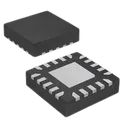
19 Uses0 StarsATTINY1616-MFR
ATTINY1616-MFR QFN-20_L3.0-W3.0-P0.40-TL-EP1.7 LCSC Part Number: C1338523 JLCPCB Part Class: Extended Part Manufactured by MICROCHIP(美国微芯) Microchip ATtiny1614/1616/1617 tinyAVR 1-series 8-bit microcontroller, AVR CPU running up to 20MHz, up to 16KB self-programmable Flash memory, 256B EEPROM and 2KB SRAM, 1.8V to 5.5V operating voltage range, single-pin UPDI programming and debug interface, power-on reset and brown-out detector, internal 16/20MHz oscillator, timers, watchdog, USART, SPI, I2C/TWI, 10-bit ADC, DAC, analog comparators, event system, configurable custom logic and peripheral touch controller, available in 14-pin, 20-pin and 24-pin packages depending on variant. Search Keywords: ATtiny1614, ATtiny1616, ATtiny1617, Microchip ATtiny1614, Microchip ATtiny1616, Microchip ATtiny1617, tinyAVR 1-series, AVR 8-bit microcontroller, ATtiny 16KB Flash, ATtiny UPDI, ATtiny1616 microcontroller, ATtiny1617 MCU, ATtiny1614 MCU, 20MHz AVR microcontroller, ATtiny I2C SPI USART, ATtiny1616 datasheet, ATtiny1614 datasheet, ATtiny1617 datasheet Hashtags: #ATtiny1614 #ATtiny1616 #ATtiny1617 #MicrochipATtiny #MicrochipMCU #tinyAVR #tinyAVR1Series #AVRMicrocontroller #8bitMicrocontroller #ATtinyMCU #UPDI #16KBFlashMCU #20MHzMCU #I2CMCU #SPIMCU #USARTMCU #ADCmicrocontroller #TouchControllerMCU
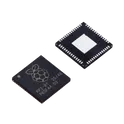
58 Uses0 StarsRP2040
133MHz LQFN-56(7x7) Microcontrollers (MCU/MPU/SOC) ROHS RP2040 The RP2040 is a high-performance, low-cost 32-bit microcontroller developed by Raspberry Pi Ltd.. It features dual ARM Cortex-M0+ processor cores, flexible digital interfaces, and a unique Programmable I/O (PIO) subsystem that enables custom hardware protocols and timing-critical applications. The device is widely used in embedded systems, IoT devices, robotics, industrial control, consumer electronics, and educational projects. Key Features Dual ARM Cortex-M0+ CPU cores operating up to 133 MHz (up to 200 MHz under specific conditions) 264 KB on-chip SRAM organized in six independent memory banks External QSPI Flash interface with Execute-In-Place (XIP) support and up to 16 MB Flash memory capability 30 multifunction GPIO pins with extensive peripheral multiplexing 2 × UART interfaces 2 × SPI controllers 2 × I²C controllers 16 PWM channels for motor control and signal generation USB 1.1 Host and Device support with integrated PHY 12-bit ADC with four external analog inputs and internal temperature sensor, up to 500 ksps sampling rate 12-channel DMA controller for efficient data transfers Programmable I/O (PIO) subsystem with 8 state machines for implementing custom communication interfaces and precise timing applications Integrated PLLs and programmable LDO regulator for clock and power management Operating voltage range: 1.8 V to 3.3 V Available in a compact 7 mm × 7 mm QFN-56 package Typical Applications IoT and connected devices Industrial automation Robotics and motor control Human-machine interfaces (HMI) Consumer electronics USB peripherals Sensor data acquisition systems Educational and maker projects Custom communication protocol implementations using PIO #CommonPartsLibrary #IntegratedCircuit #Microcontroller
153 Uses0 StarsCD74HC4067M
The CD74HC4067M is a high-speed CMOS analog multiplexer and demultiplexer designed to route one of multiple analog or digital signals to a common input/output line. Built using advanced high-speed CMOS technology, this device provides low ON-state resistance, wide signal bandwidth, and low power consumption, making it suitable for signal routing, data acquisition systems, sensor expansion, communication interfaces, industrial control systems, and embedded electronics. The integrated channel selection logic enables efficient switching between multiple signal paths while maintaining signal integrity and minimizing distortion. Features High-speed CMOS analog multiplexer and demultiplexer architecture Multiple single-ended channels connected to a common input/output Low ON-state resistance for reduced signal loss Wide analog signal handling capability Bidirectional signal switching support Compatible with both analog and digital signals Low power consumption during operation Break-before-make switching characteristic High noise immunity Wide operating supply voltage range Direct interface compatibility with microcontrollers and digital logic devices Low crosstalk and low leakage current performance Surface-mount package optimized for automated assembly Applications Sensor multiplexing systems Data acquisition equipment Industrial automation controllers Embedded electronics Test and measurement instruments Communication systems Audio signal routing Battery monitoring systems Medical instrumentation Consumer electronic products Microcontroller input expansion Analog signal selection networks Electrical Characteristics CMOS logic implementation Analog and digital signal switching capability Low propagation delay Low channel capacitance Low leakage current High switching speed Wide bandwidth operation ESD protection features High input impedance Low standby power consumption Mechanical Characteristics Surface-mount integrated circuit package Compact footprint for high-density PCB layouts RoHS-compliant construction Suitable for automated pick-and-place assembly Standard industry package dimensions Design Considerations Use proper decoupling capacitors near supply pins Keep analog signal traces short to minimize noise pickup Ensure signals remain within specified supply voltage limits Consider ON-resistance effects in precision analog applications Implement appropriate PCB grounding techniques for optimal performance Avoid exceeding maximum switching current ratings #commonpartslibrary #integratedcircuit #analog #digital #multiplexer #demultiplexer #signalrouting #analogswitch #dataacquisition #embeddedsystems #industrialelectronics #texasinstruments
108 Uses0 Stars