LEDs
A LED (light-emitting diode) is a small, energy-efficient light source that is commonly used in a variety of applications. LED technology has advanced significantly in recent years, making it a popular choice for a wide range of lighting needs. LEDs are known for their low power consumption, long lifespan, and ability to produce a bright, directional light. One of the primary use cases for LEDs is in general lighting, where they are used in everything from residential and commercial lighting to automotive and aviation lighting. LEDs are also commonly used in electronic displays, such as TVs, computer monitors, and smartphones, as well as in signaling and indication applications, such as traffic lights and exit signs. If you are looking for high-quality LED resources, flux.ai has the world's largest community-driven public library of LED footprints, symbols, datasheets, and simulation models. Whether you are a designer, engineer, or manufacturer, you can find the resources you need to work with LEDs in your projects.
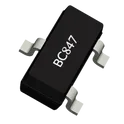
BC847
All details fully confirmed across multiple authoritative sources including Nexperia, ROHM, Farnell, and others. Here's the complete spec. Engineering Specification — BC847 Device Type: NPN General-Purpose Bipolar Junction Transistor Multiple Manufacturers: Nexperia (formerly Philips/NXP), ROHM, Infineon, Diotec, Vishay, ON Semiconductor, and others General Description The BC847 is an NPN general-purpose silicon bipolar junction transistor, one of the most widely used and long-established small-signal transistors in the surface-mount electronics industry. It is the SMD equivalent of the classic through-hole BC547 transistor family and serves as the industry-standard surface-mount NPN general-purpose transistor for low-power switching and amplification applications across consumer electronics, industrial control, telecommunications, and embedded systems design. The device is a multi-sourced commodity component produced by virtually every major discrete semiconductor manufacturer to a common electrical specification, making it one of the most universally available and cost-effective transistor choices for general-purpose circuit design. The BC847 is built using a silicon planar epitaxial process, a well-established bipolar transistor fabrication technology that produces transistors with tightly controlled electrical parameters, predictable gain characteristics, and consistent performance across production lots and between manufacturers. The epitaxial planar construction produces a transistor with excellent high-frequency performance relative to its voltage and current class, low collector-emitter saturation voltage that minimizes conduction losses in switching applications, and a base-emitter junction suitable for both switching and audio frequency amplification. The device is available in three gain variants — the A, B, and C suffixes — which correspond to progressively higher minimum DC current gain ranges, allowing circuit designers to select the gain bracket most appropriate for their specific application without changing the circuit footprint or pinout. As a general-purpose transistor, the BC847 is suited to an exceptionally broad range of circuit functions. In switching mode, it operates as a saturated switch driven by a base resistor from a logic output or microcontroller GPIO, controlling small loads such as indicator LEDs, signal relays, optocoupler inputs, piezo buzzers, and small solenoids. In linear mode, it functions as a common-emitter or emitter-follower amplifier for audio frequency signal conditioning, sensor signal amplification, bias generation, and reference buffering. Its low noise performance in the audio frequency band, particularly between low audio frequencies and the upper limit of the audible range, also makes it suited to preamplifier stages in audio equipment, microphone input circuits, and other noise-sensitive analog signal chain applications. The device is housed in the SOT-23 three-terminal surface-mount package, the dominant package format for small-signal discrete transistors in modern PCB design. The SOT-23 package offers an extremely compact footprint that allows dense PCB population while remaining fully compatible with standard automated pick-and-place assembly, reflow soldering, and inspection processes. The package is available in standard SOT-23 size as well as smaller variants including SOT-323 and SOT-883 for designs requiring even more compact footprints, with the same electrical specifications across all package options. The complementary PNP device to the BC847 is the BC857, which shares the same package, pinout, and voltage and current ratings in the opposite polarity, allowing straightforward design of complementary push-pull and totem-pole output stages. Spec Sheet Identification Part Number: BC847 (suffixes A, B, C denote gain groups) Device Family: BC847 series, NPN general-purpose transistor Manufacturer: Multi-sourced commodity part — Nexperia, ROHM, Infineon, Diotec, Vishay, ON Semiconductor, and others PNP Complement: BC857 Functional Classification Device Type: NPN bipolar junction transistor (BJT) Construction: Silicon planar epitaxial Application Class: General-purpose switching and amplification Gain Variants BC847A: Lowest gain range group BC847B: Mid gain range group BC847C: Highest gain range group Absolute Maximum Ratings Collector-Emitter Voltage: Standard low-voltage small-signal transistor class Collector-Base Voltage: Slightly higher than collector-emitter rating Emitter-Base Voltage: Standard emitter-base reverse voltage class Collector Current: Low continuous current class, suitable for signal and small load switching Peak Collector Current: Higher pulsed current capability Total Power Dissipation: Low power dissipation class, standard for SOT-23 package Operating Junction Temperature: Extended range, standard silicon transistor class Electrical Characteristics DC Current Gain: Variant-dependent, high gain class for general-purpose applications Collector-Emitter Saturation Voltage: Low saturation voltage for efficient switching Base-Emitter Saturation Voltage: Standard silicon junction voltage class Collector Cutoff Current: Low leakage class Transition Frequency: High-frequency capable for audio and signal switching applications Noise Figure: Low noise in audio frequency band Package & Mechanical Primary Package: SOT-23 (TO-236AB) Alternate Packages: SOT-323 (SC-70), SOT-883 (DFN1006-3) — same electrical specs Mounting Method: Surface mount technology (SMT) Pin Configuration: Base — Pin 1, Emitter — Pin 2, Collector — Pin 3 Target Applications Logic-level switching of LEDs, relays, and small loads Audio frequency signal amplification and preamplification Sensor signal conditioning and buffering Emitter follower and bias circuits Optocoupler and interface drive circuits General-purpose analog and digital circuit design Environmental & Qualification RoHS Compliance: Yes, lead-free across all manufacturer sources Flammability Rating: UL94 V-0 package material Packaging Supply Format: Tape-and-reel, per manufacturer standard packaging #BC847 #BC847B #BC847C #NPNTransistor #BipolarTransistor #BJT #SmallSignalTransistor #GeneralPurposeTransistor #SOT23 #SurfaceMountTransistor #SwitchingTransistor #AmplifierTransistor #LowPowerTransistor #SiliconEpitaxial #BC857Complement #DiscreteComponent #AnalogCircuit #EmbeddedSystems #EngineeringSpec #ComponentLibrary #CommonPartsLibrary #RoHSCompliant #CommodityPart
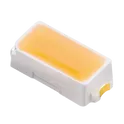
14 Uses0 Stars158301227
LED Lighting WL-SWTP White, Warm 2700K 3V 20mA 120° 1206 (3216 Metric) The 158301227 is a surface-mount white LED manufactured by Würth Elektronik, belonging to the WL-SWTP series of top-view PLCC-packaged light-emitting diodes designed for general illumination, backlighting, and signal indication applications in compact electronics. It is built on a gallium nitride semiconductor chip, the standard chip technology used in high-efficiency white LED production, which achieves white light emission by combining a blue GaN die with a phosphor conversion layer that down-converts a portion of the blue photons into broader-spectrum yellow light, with the combined blue and yellow output perceived by the human eye as white light. This particular variant is characterized by a warm white Sunrise color temperature, placing it in the lowest color temperature tier of the WL-SWTP family. Warm white light at this color temperature produces a yellowish, incandescent-like appearance that is widely preferred in residential, hospitality, and ambient lighting applications where a soft, comfortable visual environment is desired. This makes the device a natural fit for LED-based replacements for incandescent and halogen light sources in T5 and T8 fluorescent tube form factor products, as well as indoor display backlights, decorative architectural lighting, and other applications where a warm light quality is specified or preferred by end users. The WL-SWTP series features fast switching, no infrared radiation, high color rendering index, slim and miniature size, low power consumption, suitability for all SMT assembly methods, a top-view emission direction, and a wide viewing angle. The high color rendering index characteristic of this device means that objects illuminated by it appear with colors close to how they would look under natural daylight illumination, which is an important quality metric in retail, museum, medical examination, and other environments where accurate color representation enhances user experience or functional accuracy. Texas Instruments The PLCC package style used in this device is a molded plastic leaded chip carrier format that provides a well-defined, mechanically stable footprint for surface-mount assembly, with the optical emitting surface oriented perpendicular to the PCB plane in the top-view configuration. This top-view orientation makes the device suitable for direct illumination of surfaces positioned above the PCB, such as diffusers, light guides, or display panels mounted parallel to the LED board. The compact 3014 package footprint allows high-density LED arrays to be assembled on narrow PCB strips or modules, which is typical in LED tube light and edge-lit backlight designs. The device is supplied on tape-and-reel packaging suitable for automated high-speed pick-and-place assembly at production volumes. Spec Sheet Identification Part Number: 158301227 Series: WL-SWTP — SMD White Top View PLCC LED Manufacturer: Würth Elektronik GmbH & Co. KG Functional Classification Device Type: Surface-mount white LED Chip Technology: Gallium Nitride (GaN) with phosphor conversion Emission Type: White light via blue die plus phosphor down-conversion View Direction: Top view — perpendicular to PCB surface Optical Characteristics Emitting Color: Sunrise warm white Color Temperature: Warm white class, lowest CCT tier in WL-SWTP family Color Rendering Index: High CRI class, suitable for color-critical applications Viewing Angle: Wide angle, broad spatial distribution Infrared Radiation: None — no IR emission Electrical Characteristics Operating Current: Standard signal LED drive current class Forward Voltage: Standard GaN white LED forward voltage class Switching Speed: Fast switching capable Thermal Characteristics Thermal Resistance, Junction to Solder Point: Defined per series specification Maximum LED Junction Temperature: Rated to elevated junction temperature class Package & Mechanical Package Type: PLCC (Plastic Leaded Chip Carrier), PLCC-2 style Package Size: 3014 SMD footprint Mounting Method: Surface mount technology (SMT) Assembly Compatibility: Suitable for all standard SMT assembly methods including reflow soldering Target Applications Signal indication and pilot lights Indoor display backlighting General illumination and commercial lighting Replacement for PLCC 3528 devices in T8 and T5 LED tube designs Architectural and ambient lighting systems Environmental & Qualification RoHS Compliance: Yes REACH Compliance: Yes Packaging Supply Format: Tape-and-reel Standard Reel Quantity: Standard volume reel per Würth packaging convention #WuerthElektronik #WuerthElectronic #WLSWTP #WhiteLED #WarmWhiteLED #SunriseLED #PLCCLED #SMDLed #3014LED #TopViewLED #GaNLED #HighCRI #LEDBacklight #GeneralIllumination #IndoorLighting #SignalLED #LightingDesign #OptoelectronicComponent #EngineeringSpec #ComponentLibrary #CommonPartsLibrary #RoHSCompliant #REACHCompliant
119 Uses0 StarsIRM-20-12
Enclosed AC DC Converters 1 Uitgang 12V - - - 1.8A 85 ~ 264 VAC, 120 ~ 370 VDC Input The IRM-20-12 is a compact enclosed AC-DC power supply module from MEAN WELL’s IRM-20 series. It is designed to convert a wide-range AC input into a stable 12V DC output, delivering reliable power for embedded systems, industrial electronics, and general-purpose PCB-mounted applications. It is a board-mount (through-hole) module with an encapsulated design, making it suitable for space-constrained and high-reliability environments. Key Features AC-DC Converter Module Converts AC mains to regulated 12V DC output Power Rating Up to 20–22W output power Output Capability 12V DC / 1.8A max current Universal Input Range 85–264 VAC (wide input compatibility) High Efficiency Around ~84% typical efficiency Compact Enclosed Design Fully encapsulated plastic case for protection and durability Through-Hole PCB Mount Designed for direct soldering onto PCB boards Low No-Load Power Consumption <0.1W standby consumption Built-in Protection Functions Overload protection Short circuit protection Overvoltage protection Wide Operating Temperature Typically -30°C to +70°C Safety Certifications UL, CE, TUV, CB approved (varies by region) EMI Compliance Designed to meet Class B EMI standards (with internal filtering) Typical Applications Industrial automation systems Factory equipment Embedded electronics IoT devices LED lighting systems Small control boards and instrumentation #CommonPartsLibrary #powersupply #ACDCconverter
36 Uses0 StarsDCB1M-IC
225k ~ 1.4M Modem PSK 32-QFN (5x5) The DCB1M is a device for multiplex communication over noisy power lines, at speed up to 1.4Mbit/s. The DCB1M is based on the DC-BUS™ technology for network communication between modules sharing a common DC or AC powerline. The device avoids complex cabling, saves weight, and simplifies installation. The DCB1M supports UART, SPI, DMX512, RDM, and I 2C protocols, enabling the user to meet this application protocol. Sleep mode allows low power consumption when the device is not used. A QFN32 5x5 mm package provides a small PCB footprint The DCB1M is beneficial for many applications ranging from LED, Aerospace, Automotive, Industrial, and even Toys. Features • Noise robust UART, SPI, DMX512, RDM, and I2C transceiver over DC powerline. • Bitrate up to 1.4Mbit/s over the powerline. • Multiple networks may operate over a single powerline. • 251 selectable carrier frequencies (5MHz to 30MHz). • Built-in CSMA/CA (powerline arbitration) mechanism. • Operates as Multi-master Transceiver in a multiplex network. • Channel interference detection. • Communicates over a wide range of DC voltages. • Power management (Sleep modes) for low power consumption.
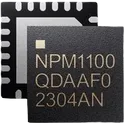
3 Uses0 StarsNPM1100-QDAA-R7
Battery Power Management IC Lithium Ion/Polymer 24-QFN (4x4) nPM1100 is an integrated Power Management IC (PMIC) with a linear-mode lithium-ion/lithium-polymer battery charger in a compact 2.1x2.1 mm WLCSP package. It has a highly efficient, dual-mode configurable output DC/DC buck regulator. nPM1100 is an extremely compact PMIC device, created for space constrained applications with a small lithium-ion or lithium-polymer battery. It is compatible with all nRF52 and nRF53 Series SoCs and supports charging batteries at up to 500 mA through USB, and also delivers up to 150 mA of current to power external components with regulated voltage. A minimum of five passive components are required for operation and the device functions without a control interface. It is the perfect companion for nRF52 and nRF53 multiprotocol SoCs in battery powered designs. Low quiescent current (IQ) extends battery life during shipping and storage with Ship mode, or in operation using auto-controlled hysteretic buck mode for high efficiency down to 1 µA loads. Charge and error indication LED drivers are built in. Charge profile limits are configurable and VBUS current limits can be fixed or auto-controlled with on-chip USB port detection. • 400 mA linear battery charger • Linear charger for lithium-ion/lithium-polymer batteries • Adjustable charge current from 20 mA to 400 mA • Selectable termination voltage of 4.1 V or 4.2 V • Automatic trickle, constant current, and constant voltage charging • Battery thermal protection • Discharge current limitation • JEITA compliant • Li-ion/Li-polymer USB battery charger with a high efficiency buck regulator • 800 nA - Typical quiescent current • 460 nA - Shipping mode quiescent current • Thermal protection • Input regulator • USB compatible current limit of 100 mA and 500 mA • 4.1 V to 6.7 V input voltage range for normal operation • 20 V overvoltage protection • Reverse current protection • 3.0 V to 5.5 V system voltage output • USB port detection supporting the following types: • SDP • CDP/DCP • 1.8 V to 3.0 V, 150 mA step-down buck regulator • Step-down buck regulator with up to 92% efficiency • Automatic transition between hysteretic and pulse width modulation (PWM) modes • Forced PWM mode for clean power operation • Pin-selectable output voltage (1.8 V, 2.1 V, 2.7 V, 3.0 V) • Soft start-up • LED drivers for charger state indication • 5 mA low side LED driver for charging indication • 5 mA low side LED driver for error indication • 2.3 V to 4.35 V battery operating input range • 2.1x2.1 mm WLCSP package • Suitable for two layer PCB design #CommonPartsLibrary #IntegratedCircuit #NordicSemiconductor #nPM1100 #PMIC #BatteryCharger #PowerManagement #LiIon #LiPolymer #BuckConverter #Wearables #IoT #WirelessSensor #LowPowerDesign #USBCharging #EmbeddedSystems #nRF52 #nRF53 #PortableElectronics
22 Uses0 StarsIP5407
IP5407 is a multi-function power management soc with integrated boost converter, lithium battery charge management, and battery power indication, providing a complete power solution for mobile power. IP5407 has high integration and rich functions, so it only needs few peripheral devices in application,effectively reduce the size of the overall solution and reduce BOM cost. IP5407's synchronous boost system provides 2.1A / 2.4A output current, and the conversion efficiency is as high as 93%. At light load, it automatically turns off the LED power indicator and maintains the 5V voltage output to sleep, and the quiescent current drops below 150uA. IP5407 uses switch charging technology to provide 2.0a current at the input, with charging efficiency up to 91%.Built-in IC internal temperature and input voltage detection and intelligent adjustment of charging current. IP5407 supports 4, 2, 1 LED power display and lighting functions. IP5407 is available in ESOP8 package. Charge and discharge of synchronous switch 2.1A / 2.4A synchronous boost conversion, 2.0A synchronous switch charging Boost efficiency up to 93% Charging efficiency up to 91% Built-in power supply path management, supporting charging and discharging at the same time Double click to turn on the Output supports linear compensation of 60mV charging Automatically adjust the charging current to match the output capability of the adapter Support 4.20V,4.35V batteries Power display Support 4/2/1 LED power display Supports 4 light models: IP5407 Support 2/1 light models: IP5407_2D1D Multifunction Built-in floodlight driver Automatically detect phone insertion and removal Integrated mobile phone charging current intelligent identification DCP Support battery NTC temperature protection. Low power consumption Output fixed normally open 5V Standby power consumption is less than 150uA BOM are simple and few Built-in power MOS, single inductor realizes charging and discharging Multiple protections and high reliability Output over-current, over-voltage, short-circuit protection Input overvoltage, overcharge, overdischarge, overcurrent discharge protection over-temperature protection #IP5407 #Injoinic #PowerBankSOC #BatteryCharger #BoostConverter #PowerManagementIC #LithiumBattery #USBCharging #PortablePower #EmbeddedSystems
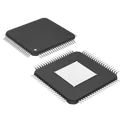
2 Uses0 StarsLAN9254-I/JRX
Ethernet Controller 10/100 Base-T/TX Bus Interface 80-TQFP-EP (12x12) The LAN9254-I/JRX is an EtherCAT SubDevice (slave) controller developed by Microchip Technology, designed to serve as the communication backbone for industrial automation devices participating in an EtherCAT network. The device integrates dual Ethernet physical layer transceivers directly on-chip, eliminating the need for external PHY components and simplifying the design of EtherCAT-enabled equipment such as servo drives, sensors, I/O modules, and other field devices used in real-time industrial control systems. Architecturally, the controller can operate as either a two-port or three-port node, depending on the network topology required. In its standard configuration it functions as a two-port device supporting daisy-chain connections typical of EtherCAT line topologies. When configured as a three-port device, it gains an additional management interface port that can connect to an external PHY or to another LAN9254, enabling star or tree network topologies and allowing the device to act as a branching point within a larger EtherCAT installation. Each integrated Ethernet PHY operates in full-duplex mode and supports automatic crossover detection, so the device can use either straight-through or crossover cabling without requiring manual configuration. Beyond pure protocol handling, the LAN9254 includes a substantial set of general-purpose digital input and output lines, allowing it to be used in simple field devices without requiring a separate microcontroller. For more complex applications, the device communicates with an external host processor through an integrated host bus interface that behaves like simple memory-mapped SRAM, supporting both 8-bit and 16-bit data widths along with multiple byte-ordering conventions, which makes it straightforward to interface with a wide range of microcontroller and microprocessor architectures. Internally, dual process data RAM buffers manage the exchange of real-time process data between the host application and the EtherCAT communication engine, while a dedicated interrupt line notifies the host of relevant internal events. A key feature of the device is its built-in distributed clock mechanism, which provides high-precision timing synchronization across all nodes in an EtherCAT network. This capability is essential for motion control and other applications where multiple devices must act in tight temporal coordination. The controller also provides configurable status indication through standard network activity and link LEDs, along with optional error and run-state indicators that give visibility into the health and operational state of the device at a glance. Power architecture on the LAN9254 is simplified through an integrated linear regulator, allowing the device to be operated from a single primary supply rail while internally generating the lower voltage needed for its core logic. This reduces the external power supply complexity that would otherwise be required to support separate core and I/O voltage domains. The "-I" designation on this particular part number indicates an industrial-grade temperature rating, making it suitable for deployment in factory floor and other demanding industrial environments where extended thermal range and long-term reliability are required. The device is housed in a surface-mount package consistent with dense industrial control board layouts and is compliant with RoHS material restrictions. Spec Sheet Identification Part Number: LAN9254-I/JRX Device Family: LAN9254 Manufacturer: Microchip Technology Functional Classification Device Type: EtherCAT SubDevice (slave) controller Network Role: Two/three-port configurable node Integrated PHYs: Dual Ethernet physical layer transceivers, on-chip Auto-MDIX Support: Yes, supports direct and crossover cabling Communication & Protocol Features Protocol: EtherCAT Topology Support: Daisy-chain (line), star, and tree topologies Additional Port Mode: Optional third port for branching/tap configurations Clock Synchronization: Integrated distributed clock for high-precision timing Host Interface Interface Type: SRAM-like host bus interface Data Width Support: Selectable bit-width host bus operation Endianness Support: Multiple byte-ordering modes Process Data Handling: Dual process data RAM buffers Interrupt Support: Configurable host interrupt line Digital I/O General-Purpose I/O: Integrated digital I/O lines for microcontroller-less operation Standalone Mode: Supports operation without external microcontroller for simple device designs Power Architecture Supply Configuration: Single primary supply rail Internal Regulation: Integrated linear regulator for core voltage generation Status Indication LED Support: Standard run and link/activity indicators per port Optional Indicators: Configurable error and run-state status indicators Environmental & Qualification Temperature Grade: Industrial ("-I" suffix) RoHS Compliance: Yes Package Package Type: Surface-mount, quad flat package style Mounting: Surface mount technology (SMT) Packaging Format Supply Format: Tape-and-reel, per part suffix designation #LAN9254 #Microchip #EtherCAT #SlaveController #SubDeviceController #IndustrialEthernet #IndustrialAutomation #MotionControl #EmbeddedSystems #FieldDevice #DigitalIO #HostBusInterface #DistributedClock #TQFP #RoHSCompliant #IndustrialGrade #EngineeringSpec #ComponentLibrary #CommonPartsLibrary #SemiconductorIC
1 Uses0 Stars