Oscillators
An oscillator is an electronic circuit that generates a periodic, oscillating signal, often a sine wave or a square wave. Oscillators are used in a wide range of applications, including clocks, radios, and sound synthesis. Flux.ai has the world's largest community-driven public library of oscillators, with footprints, symbols, datasheets, and simulation models. This comprehensive resource allows engineers and designers to easily find the oscillator they need for their specific application and use it with confidence. Whether you are working on a simple clock circuit or a complex radio transmitter, Flux.ai's oscillator library has you covered. So, if you are in need of an oscillator for your next project, be sure to check out Flux.ai's extensive collection.
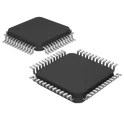
STM32F103C8T6
ARM® Cortex® M3 STM32F1 Microcontroller IC 32-Bit Single-Core 72MHz 64KB (64K x 8) FLASH Medium-density performance line Arm®-based 32-bit MCU with 64 or 128 KB Flash, USB, CAN, 7 timers, 2 ADCs, 9 com. interfaces Arm® 32-bit Cortex®-M3 CPU core – 72 MHz maximum frequency, 1.25 DMIPS/MHz (Dhrystone 2.1) performance at 0 wait state memory access – Single-cycle multiplication and hardware division • Memories – 64 or 128 Kbytes of Flash memory – 20 Kbytes of SRAM • Clock, reset and supply management – 2.0 to 3.6 V application supply and I/Os – POR, PDR, and programmable voltage detector (PVD) – 4 to 16 MHz crystal oscillator – Internal 8 MHz factory-trimmed RC – Internal 40 kHz RC – PLL for CPU clock – 32 kHz oscillator for RTC with calibration • Low-power – Sleep, Stop and Standby modes – VBAT supply for RTC and backup registers • 2x 12-bit, 1 µs A/D converters (up to 16 channels) – Conversion range: 0 to 3.6 V – Dual-sample and hold capability – Temperature sensor • DMA – 7-channel DMA controller – Peripherals supported: timers, ADC, SPIs, I 2Cs and USARTs • Up to 80 fast I/O ports – 26/37/51/80 I/Os, all mappable on 16 external interrupt vectors and almost all 5 V-tolerant Debug mode: – Serial wire debug (SWD) and JTAG interfaces • Seven timers – Three 16-bit timers, each with up to 4 IC/OC/PWM or pulse counter and quadrature (incremental) encoder input – 16-bit, motor control PWM timer with dead-time generation and emergency stop – Two watchdog timers (independent and window) – SysTick timer 24-bit downcounter • Up to nine communication interfaces – Up to two I2C interfaces (SMBus/PMBus®) – Up to three USARTs (ISO 7816 interface, LIN, IrDA capability, modem control) – Up to two SPIs (18 Mbit/s) – CAN interface (2.0B Active) – USB 2.0 full-speed interface • CRC calculation unit, 96-bit unique ID • Packages are ECOPACK #commonpartslibrary #integratedcircuit #microcontroller #stm32f1
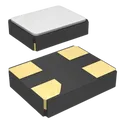
36 Uses0 StarsCX3225SB16000D0GZJC1
16 MHz ±15ppm Crystal 8pF 60 Ohms 4-SMD, No Lead The CX3225SB16000D0GZJC1, manufactured by Kyocera AVX, is a 16.000 MHz crystal oscillator element designed to provide precise frequency reference for microcontrollers, communication ICs, and digital systems. It belongs to the CX3225SB series, known for compact size and stable frequency performance. Key Characteristics Type: Quartz crystal (passive frequency component) Frequency: 16 MHz Load Capacitance: 8 pF Frequency Stability: ±15 ppm Frequency Tolerance: ±15 ppm Operating Mode: Fundamental ESR (Equivalent Series Resistance): ~60–80 Ω Mechanical Details Package: 4-SMD, no-lead (surface mount) Size: 3.2 mm × 2.5 mm (3225 package) Height: ~0.6 mm (low profile) Operating Conditions Temperature Range: −25°C to +85°C Mounting Type: Surface mount (SMT) Function (Simple Explanation) This component: Generates a stable clock signal (16 MHz) Acts as the timing reference for MCUs, processors, or RF modules Works together with internal oscillator circuits inside ICs Microcontroller clock sources (e.g., ESP32, STM32, AVR) Communication modules Embedded systems Consumer electronics IoT devices #CommonPartsLibrary #Crystal #Oscillator #resonator
189 Uses0 StarsKPEG112
The KPEG112 is a piezoelectric sounder / passive piezo transducer commonly used for audible signaling such as beeps, alarms, and electronic alerts. It works by converting an electrical AC signal into mechanical vibration through a piezoelectric ceramic element, producing sound. Type: Passive piezoelectric transducer (not an active buzzer) Operation: Requires an external driving signal (PWM or oscillator) Construction: Piezo ceramic disk inside a plastic housing Sound Output: Tone depends on input frequency (typically in the kHz range) Terminals: 2-pin connection (generally non-polarized) #CommonPartsLibrary #Audio-Product #Alarm #Buzzer #Siren
14 Uses0 Stars