Microcontrollers
A microcontroller is a small, low-cost computer-on-a-chip that can be used to control electronic devices and systems. It consists of a central processing unit (CPU), memory, input/output (I/O) ports, and other peripherals integrated onto a single chip. Microcontrollers are commonly used in a wide range of applications, including automotive systems, home appliances, industrial automation, and consumer electronics. One of the key benefits of microcontrollers is their ability to interact with their environment through sensors and actuators, making them well-suited for use in embedded systems. These systems are often found in devices that require real-time control or data processing, such as medical equipment, aircraft, and factory automation systems. Flux.ai is home to the world's largest community-driven public library of microcontrollers, with footprints, symbols, datasheets, and simulation models for a wide range of devices. Whether you're a professional engineer looking for a specific microcontroller for your next project, or a hobbyist exploring the possibilities of microcontroller-based systems, Flux.ai has the resources you need to get started.
TSW-122-07-G-S
Connector Header Through Hole 22 position 0.100" (2.54mm) PinHeader_1x22_P2.54mm_Vertical General Description The TSW-122-07-G-S is a through-hole vertical pin header manufactured by Samtec. It is part of the TSW series, designed for board-to-board or wire-to-board interconnections. This component features a single-row configuration with standard 2.54 mm pitch spacing, making it widely compatible with common prototyping and production PCB designs. It is commonly used in embedded systems, development boards, and general-purpose electronic assemblies requiring reliable and cost-effective connectivity. Key Features Single-row vertical pin header Through-hole mounting style Standard 2.54 mm pitch spacing Tin-plated contacts for reliable electrical connection Black thermoplastic insulator housing Designed for board-to-board or cable interfacing Compatible with standard mating connectors and sockets Electrical Characteristics Current rating suitable for signal-level and low-power applications Contact resistance designed for stable electrical performance Insulation resistance suitable for typical PCB environments Mechanical Characteristics Number of positions: twenty-two Row configuration: single row Mounting type: through-hole Orientation: vertical Contact material: copper alloy Contact plating: tin Housing material: high-temperature thermoplastic Environmental Characteristics Operating temperature range suitable for industrial and commercial electronics RoHS compliant Designed for durability under normal handling and soldering conditions Applications Microcontroller and development boards Prototyping platforms Board-to-board interconnections Embedded systems General electronic assemblies #commonpartslibrary #connector #header
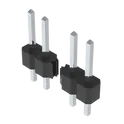
39 Uses0 StarsTSW-105-07-G-D
Connector Header Through Hole 10 position 0.100" (2.54mm) The TSW-105-07-G-D is part of the Samtec TSW series, which consists of 0.100″ (2.54 mm) pitch PCB header strips. It is a dual-row, 10-position (2×5) male pin header intended for through-hole mounting on printed circuit boards. This connector provides a simple and reliable way to connect PCBs or interface with cables and other connectors (e.g., female sockets or IDC connectors). Key Features Connector Type: Rectangular header (male pin) Mounting Type: Through-hole (THT) Pitch: 2.54 mm (0.100″ standard spacing) Number of Positions: 10 pins Rows: Dual-row (2×5 configuration) Contact Style: 0.025″ (0.635 mm) square posts Orientation: Vertical (straight header) Plating: Gold (indicated by “G”) for reliable contact Electrical & Mechanical Highlights Current Rating: up to ~6.3 A per contact (series typical) Voltage Rating: up to ~400–550 VAC Operating Temperature: approx. -55 °C to +125 °C High durability: supports multiple mating cycles (extended-life design) Typical Applications Microcontroller and development boards Board-to-board connections Prototyping systems (breadboard-compatible headers) Industrial and embedded electronics Cable-to-board interfaces #CommonPartsLibrary #Connector #Header #TSW
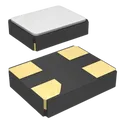
265 Uses0 StarsCX3225SB16000D0GZJC1
16 MHz ±15ppm Crystal 8pF 60 Ohms 4-SMD, No Lead The CX3225SB16000D0GZJC1, manufactured by Kyocera AVX, is a 16.000 MHz crystal oscillator element designed to provide precise frequency reference for microcontrollers, communication ICs, and digital systems. It belongs to the CX3225SB series, known for compact size and stable frequency performance. Key Characteristics Type: Quartz crystal (passive frequency component) Frequency: 16 MHz Load Capacitance: 8 pF Frequency Stability: ±15 ppm Frequency Tolerance: ±15 ppm Operating Mode: Fundamental ESR (Equivalent Series Resistance): ~60–80 Ω Mechanical Details Package: 4-SMD, no-lead (surface mount) Size: 3.2 mm × 2.5 mm (3225 package) Height: ~0.6 mm (low profile) Operating Conditions Temperature Range: −25°C to +85°C Mounting Type: Surface mount (SMT) Function (Simple Explanation) This component: Generates a stable clock signal (16 MHz) Acts as the timing reference for MCUs, processors, or RF modules Works together with internal oscillator circuits inside ICs Microcontroller clock sources (e.g., ESP32, STM32, AVR) Communication modules Embedded systems Consumer electronics IoT devices #CommonPartsLibrary #Crystal #Oscillator #resonator
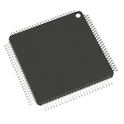
174 Uses0 StarsPIC32MZ2048EFM100-I/PT
MIPS32® M-Class PIC® 32MZ Microcontroller IC 32-Bit 200MHz 2MB (2M x 8) FLASH 100-TQFP (12x12) The PIC32MZ2048EFM100-I/PT is built around a MIPS32® M-Class core operating at up to 200 MHz, delivering high computational performance suitable for real-time control, signal processing, and communication-intensive systems. It integrates large on-chip memory, multiple communication interfaces, and rich peripheral support in a compact package. Key Features Core Architecture: 32-bit MIPS32® M-Class CPU Clock Speed: Up to 200 MHz Program Memory: 2 MB Flash RAM: 512 KB Package: 100-pin TQFP (12×12 mm), surface-mount Operating Voltage: 2.1 V to 3.6 V I/O Pins: Up to 78 programmable I/O Integrated Peripherals & Interfaces Communication Interfaces: CAN, Ethernet, USB OTG I²C, SPI, SQI, UART/USART Parallel Master Port (PMP) Analog Features: 40-channel, 12-bit ADC System Peripherals: DMA controller PWM modules Watchdog timer (WDT) Brown-out reset and power-on reset Advanced Features: Floating Point Unit (FPU) for fast math operations Hardware crypto engine (AES, SHA, etc., depending on variant) High-speed USB and Ethernet connectivity #CommonPartsLibrary #IntegratedCircuit #Microcontroller #PIC® 32MZ
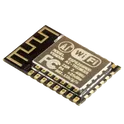
4 Uses0 StarsESP-12F
WiFi 802.11b/g/n Transceiver Module 2.4GHz ~ 2.5GHz Integrated, Trace Surface Mount The ESP-12F is a compact WiFi module based on the ESP8266EX, widely used in IoT and embedded systems due to its low cost and built-in networking capabilities. Integrated WiFi (2.4 GHz) Supports 802.11 b/g/n Built-in TCP/IP stack (no external WiFi processor needed) Microcontroller + WiFi in one Powered by the ESP8266EX SoC Can run user applications directly (not just a WiFi modem) Flash Memory Typically 4 MB SPI flash (varies by version) GPIO Support Multiple multifunction pins: Digital I/O PWM I2C SPI UART ADC (1 channel) Size: ~16 mm × 24 mm Mounting: Castellated SMD module Antenna: Built-in PCB trace antenna (requires proper keepout zone) Power Requirements Operating Voltage: 3.0V – 3.6V (typical 3.3V) Current Consumption: Idle: ~70 mA Peak (TX): up to ~300 mA Common Interfaces UART – programming and debugging SPI – peripheral communication I2C (software-based) GPIO – general-purpose control #commonpartslibrary #transceiver #module #wireless #rf #wifi
186 Uses0 StarsPEC06SAAN
Connector Header Through Hole 6 position 0.100" (2.54mm) The PEC06SAAN is a compact, low-cost incremental rotary encoder manufactured by Bourns. It is designed for user interface applications requiring precise rotational input, such as volume controls, menu navigation, and position sensing. This encoder provides reliable quadrature output signals and is suitable for through-hole PCB mounting. Its robust mechanical design ensures long operational life and consistent performance in consumer and industrial electronics. Key Features Incremental (relative) rotary encoder Compact, space-saving design Through-hole mounting configuration Quadrature output (A and B channels) Optional integrated push switch (depending on variant) Detent and non-detent options available High reliability with long rotational life RoHS compliant Electrical Characteristics Supply voltage: Typically 5 VDC (logic-level output) Output type: Digital quadrature (A/B signals) Contact resistance: ≤ 100 mΩ Insulation resistance: ≥ 100 MΩ @ 250 VDC Dielectric strength: 300 VAC for 1 minute Mechanical Characteristics Rotation type: Incremental Number of pulses per revolution (PPR): Typically 6 to 24 (variant dependent) Detent positions: Variant dependent Rotational torque: 10 to 70 gf·cm (typical range) Shaft length: Varies by suffix (e.g., 15 mm typical) Shaft type: Knurled or D-cut (variant dependent) Mounting type: Through-hole PCB Terminal type: PC pins Environmental Specifications Operating temperature range: −30°C to +70°C Storage temperature range: −40°C to +85°C Humidity: Up to 85% RH (non-condensing) Mechanical Life Rotational life: Up to 30,000 cycles (typical) Physical Dimensions Body size: Approximately 12 mm × 11 mm × 5 mm (excluding shaft) Shaft diameter: Typically 6 mm Pin pitch: Standard 2.54 mm Applications Consumer electronics (audio controls, appliances) Industrial control panels Embedded systems and microcontroller interfaces Automotive user interfaces Instrumentation and test equipment #commonpartslibrary #connector #header
32 Uses0 StarsRK860-2
Buck Switching Regulator IC 0.5V~1.5V 1 Output 7A WLCSP-20 The RK860-2 is a low-dropout (LDO) linear voltage regulator IC designed to provide a stable, low-noise output voltage from a higher input supply. It is commonly used in small electronic modules, microcontroller power rails, and low-power analog/digital circuits where clean voltage regulation is important. Type: Low Dropout Linear Regulator (LDO) Input voltage: Typically up to ~6V (varies by variant) Output voltage: Fixed or adjustable (depends on suffix version) Dropout voltage: Low (suitable for battery-powered systems) Output current: ~300 mA to 600 mA class (package dependent) #CommonPartsLibrary #IntegratedCircuit #PowerManagement #RK860
7 Uses0 StarsLMS7002M
IC RF TxRx + MCU Cellular CDMA, GSM, HSPA, LTE, TD-SCDMA, WCDMA 100kHz ~ 3.8GHz 261-SMD Module The LMS7002M is a Field Programmable RF (FPRF) transceiver that can both transmit and receive radio signals over a very wide frequency range. It integrates most of the RF front-end and baseband processing functions into a single chip, minimizing the need for external components. Frequency range: 100 kHz to 3.8 GHz Architecture: Dual transceiver (2 TX + 2 RX) supporting 2×2 MIMO Bandwidth: Up to ~120–160 MHz RF bandwidth depending on configuration Technology: CMOS-based for low cost and power consumption Integrated blocks: ADCs & DACs (12-bit) LNAs and PA drivers Mixers, PLL synthesizers Filters and gain control On-chip DSP and microcontroller Transmit path: Digital baseband → DAC → filtering → RF upconversion → output Receive path: RF input → LNA → downconversion → filtering → ADC → digital processing This zero-IF (direct conversion) architecture simplifies design and supports wideband operation. #CommonPartsLibrary #IntegratedCircuit #LMS7002
3 Uses0 Stars