Battery Management ICs
A Battery Management IC is a specialized microcontroller that monitors and manages the charging and discharging of a lithium-ion or other type of battery. These ICs are essential for ensuring the safe and efficient operation of batteries in a wide range of applications, including portable electronics, electric vehicles, and renewable energy systems. One of the key functions of a Battery Management IC is to optimize the charging and discharging of a battery by controlling the flow of current. This can help to extend the life of the battery and improve its overall performance. In addition to controlling the charging and discharging of a battery, a Battery Management IC can also perform other functions such as monitoring the temperature and voltage of the battery, protecting the battery from overcharge and overdischarge, and providing diagnostic information about the battery's health. Flux.ai has the world's largest community-driven public library of Battery Management ICs, with footprints, symbols, datasheets, and simulation models available for use. Whether you are a designer, engineer, or researcher, the Flux.ai library is an invaluable resource for finding the right Battery Management IC for your project.
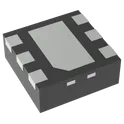
TMP117AIDRVR
Temperature Sensor Digital, Local -55°C ~ 150°C 16 b 6-WSON (2x2) The TMP117AIDRVR is a high-precision digital temperature sensor manufactured by Texas Instruments. The device provides accurate temperature measurements through an I²C-compatible digital interface and is optimized for applications requiring medical-grade accuracy, low power consumption, and compact PCB footprint. The sensor integrates a precision temperature sensing element, analog-to-digital converter, calibration memory, and digital interface into a single compact package. The device supports continuous conversion and shutdown operating modes, enabling efficient thermal monitoring in battery-powered and always-on systems. Internal calibration minimizes external component requirements while providing highly linear and repeatable temperature measurements across an extended operating range. The TMP117AIDRVR is commonly used in industrial controls, wearable electronics, healthcare equipment, environmental monitoring systems, battery management systems, consumer electronics, and precision instrumentation. Electrical Characteristics Supply voltage supports low-voltage digital systems and portable electronics applications. Ultra-low operating current enables long battery life in energy-sensitive designs. Integrated EEPROM allows programmable offset correction and configuration storage. Digital output eliminates the need for external ADC circuitry. High measurement resolution supports precision thermal monitoring applications. Low self-heating characteristics improve measurement stability and accuracy. Functional Features High-accuracy digital temperature sensing. I²C and SMBus compatible communication interface. Programmable alert functionality for thermal threshold monitoring. Continuous conversion and low-power shutdown operating modes. Integrated non-volatile memory for user configuration storage. Wide operating temperature range for industrial and commercial environments. Fast conversion timing suitable for real-time monitoring systems. Factory-calibrated performance requiring minimal external calibration. Package Information Package type is WSON with compact surface-mount footprint suitable for dense PCB layouts. Moisture-sensitive package designed for automated assembly processes. Lead-free and RoHS-compliant construction. Typical Applications Medical thermometers and patient monitoring systems. Industrial temperature monitoring equipment. Battery-powered portable electronics. HVAC and environmental sensing systems. Data acquisition and instrumentation systems. Server and embedded thermal management applications. Consumer electronics requiring precision thermal sensing. #commonpartslibrary #integratedcircuit #temperaturesensor
402 Uses1 StarsMCP73831T-2ACI/OT
Charger IC Lithium Ion/Polymer SOT-23-5 The MCP73831/2 devices are highly advanced linear charge management controllers for use in spacelimited, cost-sensitive applications. The MCP73831/2 are available in an 8-Lead, 2 mm x 3 mm DFN package or a 5-Lead, SOT-23 package. Along with their small physical size, the low number of external components required make the MCP73831/2 ideally suited for portable applications. For applications charging from a USB port, the MCP73831/2 adhere to all the specifications governing the USB power bus. The MCP73831/2 employ a constant-current/constantvoltage charge algorithm with selectable preconditioning and charge termination. The constant voltage regulation is fixed with four available options: 4.20V, 4.35V, 4.40V or 4.50V, to accommodate new, emerging battery charging requirements. The constant current value is set with one external resistor. The MCP73831/2 devices limit the charge current based on die temperature during high power or high ambient conditions. This thermal regulation optimizes the charge cycle time while maintaining device reliability. Several options are available for the preconditioning threshold, preconditioning current value, charge termination value and automatic recharge threshold. The preconditioning value and charge termination value are set as a ratio or percentage of the programmed constant current value. Preconditioning can be disabled. Refer to Section 1.0 “Electrical Characteristics” for available options and the Product Identification System for standard options. The MCP73831/2 devices are fully specified over the ambient temperature range of -40°C to +85°C. Linear Charge Management Controller: - Integrated Pass Transistor - Integrated Current Sense - Reverse Discharge Protection • High-Accuracy Preset Voltage Regulation: + 0.75% • Four Voltage Regulation Options: - 4.20V, 4.35V, 4.40V, 4.50V • Programmable Charge Current: 15 mA to 500 mA • Selectable Preconditioning: - 10%, 20%, 40%, or Disable • Selectable End-of-Charge Control: - 5%, 7.5%, 10%, or 20% • Charge Status Output - Tri-State Output - MCP73831 - Open-Drain Output - MCP73832 • Automatic Power-Down • Thermal Regulation • Temperature Range: -40°C to +85°C • Packaging: - 8-Lead, 2 mm x 3 mm DFN - 5-Lead, SOT-23 Applications • Lithium-Ion/Lithium-Polymer Battery Chargers • Personal Data Assistants • Cellular Telephones • Digital Cameras • MP3 Players • Bluetooth Headsets • USB Chargers #commonpartslibrary #integratedcircuit #powermanagement #batterycharger
1.1k Uses0 StarsBQ24075TRGTR
1.5A USB-Friendly Li-Ion Battery Charger and Power-Path Management IC with 4.2 VBAT The BQ24075TRGTR (from Texas Instruments) is a highly integrated single-cell Li-Ion / Li-Polymer linear battery charger IC with power-path management. It is designed for portable and space-constrained applications, allowing a device to be powered from a USB port or AC adapter while simultaneously charging the battery. The device integrates charging control, power-path management, and safety features into a compact package. A key feature is its Dynamic Power Path Management (DPPM), which ensures the system is powered even when the battery is low or absent, while intelligently managing charging current. Key Features Battery Charging Supports single-cell Li-Ion / Li-Polymer batteries Up to 1.5 A programmable charge current Three-phase charging: Pre-charge (conditioning) Constant current Constant voltage Fixed 4.2 V charge voltage Power Path Management Dynamic Power Path Management (DPPM): Powers system and charges battery simultaneously Prioritizes system load over charging Allows system operation even with: Deeply discharged battery No battery connected Input & Power Features Operates from: USB input (100 mA / 500 mA selectable) AC adapter Programmable input current limit up to 1.5 A Input voltage range: ~4.35 V to 6.4 V (28 V max rating) Input dynamic power management (VIN-DPM) prevents source overload Protection & Safety Thermal regulation and shutdown Over-voltage protection (OVP) Short-circuit and reverse current protection Battery temperature monitoring (NTC thermistor input) Battery disconnect (SYSOFF) feature Control & Status Standalone operation (no MCU required, resistor-programmable) Charge status outputs: Charging Charge complete Power good Physical Characteristics Package: 16-pin VQFN (3 mm × 3 mm) Operating temperature: –40°C to +85°C #commonpartslibrary #integratedcircuit #powermanagement #batterycharger
657 Uses0 StarsSTUSB4500QTR
USB Controller USB 2.0 I2C Interface 24-QFN (4x4) The STUSB4500QTR is a standalone USB Type-C Power Delivery (PD) controller from STMicroelectronics designed for power sink applications (devices that receive power, like chargers, IoT devices, or battery-powered systems). It enables automatic negotiation of USB Power Delivery contracts (up to 100 W: 20 V / 5 A) without requiring an external microcontroller, thanks to its built-in auto-run algorithm. Power profiles (PDOs) can be pre-configured and stored in internal non-volatile memory, simplifying system design and reducing component count. The device is optimized for modern USB-C designs, offering robust protection, high-voltage tolerance, and support for operation even from a dead battery state. Key Features Power Delivery & Control Standalone USB Type-C™ and USB PD sink controller Supports up to 100 W (20 V, 5 A) power negotiation Auto-run mode (no MCU required) for PD negotiation Up to 3 configurable sink PDO profiles stored in NVM Power Management Dead battery mode support (can start with no battery power) Dual power supply inputs: V<sub>SYS</sub>: 3.0 V – 5.5 V V<sub>DD</sub>: 4.1 V – 22 V Integrated VBUS monitoring and control Integrated Functions Built-in VBUS switch gate drivers (PMOS) Internal/external VBUS discharge paths I²C interface for configuration and monitoring Protection & Reliability Short-to-VBUS protection on CC pins (up to 22 V) High-voltage tolerance: Up to 28 V on VBUS pins ESD protection: 3 kV HBM / 1.5 kV CDM Physical & Environmental Package: QFN-24 (4×4 mm) Operating temperature: –40°C to +105°C Industrial-grade reliability Compliance & Compatibility Certified for: USB Type-C Rev 1.2 USB PD Rev 2.0 Interoperable with USB PD 3.0 #commonpartslibrary #integratedcircuit #usbcontroller
599 Uses0 StarsLM74700QDDFRQ1
OR Controller N+1 ORing Controller N-Channel 1:1 TSOT-23-8 The LM74700QDDFRQ1 is an automotive-qualified ideal diode controller designed to provide reverse polarity protection, reverse current blocking, and input power path management in low-voltage DC power systems. The device controls an external N-channel MOSFET to emulate an ideal diode with very low forward voltage drop and reduced power dissipation compared to conventional Schottky diodes. It is optimized for automotive and industrial applications requiring robust protection against negative supply voltages, load dump conditions, and reverse battery events. The controller supports wide input voltage operation and integrates fast response circuitry for fault handling and transient protection. The device is suitable for power OR-ing, hot-swap, redundant power supply systems, and battery-connected applications where efficiency, reliability, and thermal performance are critical. Engineering Specification Device Type Automotive ideal diode controller with reverse battery and reverse current protection Qualification Standard AEC-Q100 qualified for automotive applications Control Topology External N-channel MOSFET controller for ideal diode operation Input Voltage Range Supports wide automotive and industrial supply voltage ranges Reverse Polarity Protection Provides protection against negative input voltage conditions and reverse battery connection Reverse Current Blocking Actively prevents reverse current flow during output-to-input fault conditions Forward Voltage Drop Low conduction losses through external MOSFET control for high-efficiency power delivery Transient Protection Capable of handling automotive transient events including load dump conditions Gate Drive Control Integrated gate driver optimized for fast MOSFET switching and protection response Power Path Management Supports power OR-ing and redundant supply architectures Fault Response Fast turn-off during reverse current and fault events Current Consumption Low operating quiescent current suitable for always-on systems Thermal Performance Designed for efficient thermal operation with external MOSFET-based power dissipation Operating Temperature Range Automotive-grade extended temperature operation Package Type Small-outline automotive package suitable for compact PCB layouts #commonpartsLibrary #integratedcircuit #powermanagement #orcontroller
1.0k Uses0 StarsBQ25792RQMR
Charger IC Lithium Ion/Polymer 29-VQFN-HR (4x4) The BQ25792 is a switch-mode synchronous buck-boost charger with full power-path management. It can automatically regulate power flow between the input source, system load, and battery. It supports a wide input range and is designed for USB Type-C™ / USB Power Delivery (USB-PD) systems, enabling both charging and OTG (power output from battery) operation. ⭐ Key Features ⚡ High-performance charging Up to 5 A charge current Supports 1S to 4S battery packs High efficiency (up to ~96% under typical conditions) Programmable switching frequency: 750 kHz or 1.5 MHz 🔋 Wide input support Input voltage range: 3.6 V to 24 V Absolute max rating up to 30 V Supports USB adapters and barrel jack sources Detects USB charging standards (BC1.2, DCP, CDP, HVDCP, etc.) 🔄 Buck-boost power conversion Seamless buck, boost, and buck-boost operation Maintains stable system voltage even when battery is low or input varies 🔌 USB-PD / OTG support USB Power Delivery (PD 3.0 compatible) Supports OTG output (battery powers USB port) OTG voltage range: 2.8 V to 22 V 🧠 Intelligent power management NVDC power path management (system can run without battery) Dual-input power mux controller (select between two power sources) Battery supplement mode (prevents input overload) 📊 Monitoring & control Integrated 16-bit ADC for voltage, current, temperature monitoring Fully I²C configurable Autonomous or host-controlled operation 🛡️ Protection & safety Input and battery over-voltage/over-current protection Thermal regulation and shutdown Charging safety timer MOSFET protection (internal switching FETs included) 📦 Package 29-pin VQFN (4 mm × 4 mm) package Industrial temperature range: -40°C to 85°C #CommonPartsLibrary #IntegratedCircuit #PowerManagement #Battery-charger
49 Uses0 StarsLM66100DCKR
OR Controller P-Channel 1:1 SC-70-6 The LM66100DCKR is an ideal diode and power path management device manufactured by Texas Instruments. This integrated circuit is designed to provide low-loss reverse polarity protection and automatic power path control for low-voltage DC power systems. By utilizing an integrated low-resistance MOSFET architecture, the device significantly reduces forward voltage drop and power dissipation compared to conventional Schottky diodes. The device supports automatic source selection, reverse current blocking, and efficient power OR-ing functionality, making it suitable for battery-powered devices, USB-powered electronics, industrial embedded systems, portable equipment, and redundant power supply architectures. Its ultra-low forward voltage characteristics improve overall system efficiency and help extend battery operating life in portable applications. The LM66100DCKR is optimized for compact embedded designs requiring efficient power routing, input protection, and seamless power source switching while minimizing thermal losses and PCB footprint requirements. Engineering Specification Device Type Ideal diode and power path protection IC Power Management Function Reverse current blocking and automatic power path control Switching Technology Integrated low-resistance MOSFET architecture Reverse Protection Reverse polarity and reverse current protection Forward Voltage Characteristics Ultra-low forward voltage drop for high-efficiency operation Power Path Features Automatic source selection and power OR-ing support Efficiency Characteristics Reduced conduction loss compared to conventional diode solutions Input Characteristics Designed for low-voltage DC power rail operation Thermal Characteristics Low thermal dissipation due to efficient MOSFET conduction Protection Features Reverse current blocking Reverse polarity protection Power path isolation Fault-tolerant operation Package Type SC70 surface-mount package Mounting Style Surface mount technology Applications Battery-powered electronics USB-powered systems Power multiplexing Portable devices Embedded systems Industrial electronics Redundant power supplies Power OR-ing circuits IoT hardware Low-power electronic systems Manufacturer Texas Instruments #commonpartslibrary #idealdiode #powermanagement #reversepolarityprotection #powerpathcontroller #texasinstruments #powerelectronics #embeddedhardware #portableelectronics #surfaceountcomponents #electronicsdesign #powersupply #usbpower #batterypowered #industrialelectronics
393 Uses0 Stars



Page 1 of 3
Next