Interface ICs
An interface IC is a type of integrated circuit that is designed to facilitate communication between two devices or systems. These devices are commonly used in electronic systems to enable the transfer of data and control signals between different components or subsystems. Some common use cases for interface ICs include connecting microcontrollers to peripherals such as sensors or displays, linking multiple processors together in a network, and enabling communication between devices using different communication protocols. Flux.ai has the world's largest community-driven public library of interface ICs, with footprints, symbols, datasheets, and simulation models. This library is a valuable resource for engineers and designers who need access to accurate and up-to-date information on these important components. Whether you are working on a new design project or simply looking to learn more about interface ICs, Flux.ai is an excellent resource to help you find the information you need.
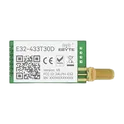
E32-433T30D
8km UART Through Hole RF Transceiver Modules and Modems RoHS,3.3V~5.2V,-40 ~ 80C The E32-433T30D is based on the Semtech SX1278 LoRa chipset and uses LoRa spread-spectrum modulation to achieve long-distance, highly reliable wireless communication even in noisy environments. It communicates with a microcontroller via UART (serial interface), making it easy to integrate with Arduino, ESP32, STM32, and similar systems. It is commonly used for IoT telemetry, remote control systems, sensor networks, and industrial monitoring, especially where GSM/Wi-Fi is unavailable or impractical. Key Features Frequency range: 410–441 MHz (433 MHz default) RF output power: 21–30 dBm (up to 1 W high-power version) LoRa modulation: High sensitivity and strong anti-interference Communication distance: up to ~8 km (open area, ideal conditions) Interface: UART TTL serial (3.3 V logic level) Sensitivity: around -147 dBm for long-range reception Low data rate support: ~0.3 kbps to 19.2 kbps Half-duplex communication (TX/RX not simultaneous) Configurable modes: normal / wake-up / power-saving / sleep via M0 & M1 pins Compact module size with SMA antenna connector Wide operating temperature: -40 °C to +85 °C Important Notes Requires external microcontroller (MCU) for operation (not standalone). Must not leave M0 and M1 pins floating (must be defined HIGH/LOW or GND). Works best with proper 433 MHz antenna (2–5 dBi recommended). Power supply must be stable (typically 5V with sufficient current capability). For maximum range, line-of-sight + correct antenna height matters more than raw power. Applications Smart agriculture monitoring Remote sensor networks Utility meter reading (water/gas) Industrial telemetry systems Drone/robot communication links Remote control & automation systems #E32_433T30D #Ebyte #LoRa #SX1278 #WirelessModule #IoT #Telemetry #LongRangeCommunication #UART #433MHzLoRa #EmbeddedSystems
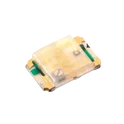
7 Uses0 Stars150080M153000
Red, Green, Blue (RGB) 624nm Red, 525nm Green, 470nm Blue LED Indication - Discrete 2V Red, 3.3V Green, 3.3V Blue 4-SMD, No Lead # 150080M153000 ## General Description The 150080M153000 is a compact surface-mount full-color RGB LED manufactured by Würth Elektronik as part of the WL-SFCD series. The device integrates red, green, and blue light-emitting elements within a single package, enabling the generation of a wide spectrum of colors for status indication, user interfaces, backlighting, visual notifications, and decorative lighting applications. Its diffused lens design provides uniform light distribution and wide viewing visibility, making it suitable for industrial equipment, consumer electronics, communication devices, instrumentation systems, control panels, and embedded electronic products. The component is optimized for automated assembly processes and offers reliable optical performance, low power consumption, and long operational life. ## Key Features ### Optical Characteristics * Full-color RGB light output * Integrated red, green, and blue emitters * Diffused lens design for uniform illumination * Wide viewing angle * High-visibility indication capability * Consistent color performance ### Electrical Characteristics * Low-power operation * Stable optical output * Suitable for indicator and backlighting applications * Reliable performance across operating conditions * Optimized for embedded electronic systems ### Mechanical Characteristics * Surface-mount package construction * Compact footprint * Low-profile package design * Compatible with automated assembly processes * Reflow-soldering compatible ### Package Construction * Common-anode configuration * Integrated multi-die LED architecture * Rectangular lens geometry * Lead-free package design * Industrial-grade construction ### Material Characteristics * High-quality encapsulation materials * Diffused optical lens * RoHS-compliant construction * Environmentally compliant materials ### Environmental Characteristics * Suitable for commercial and industrial applications * Long operational service life * Reliable operation under standard environmental conditions * Resistant to normal assembly and handling processes ### Application Areas * Status Indicators * User Interface Displays * Industrial Control Panels * Consumer Electronics * Home Appliances * Telecommunications Equipment * Instrumentation Systems * Backlighting Applications * Smart Devices * Embedded Electronic Products * Safety and Security Equipment * Human-Machine Interface Systems ### Compliance * RoHS Compliant * REACH Compliant * Lead-Free Compatible * Industry-Standard Surface-Mount Technology ## Manufacturer Würth Elektronik ## Product Family WL-SFCD SMD Full-Color Chip LED Series #150080M153000 #WurthElektronik #RGBLED #SMDLED #WLSFCD #FullColorLED #LEDIndicator #Backlighting #Optoelectronics #EmbeddedSystems #IndustrialElectronics #ConsumerElectronics #PCBDesign #ElectronicsEngineering #SMTAssembly #commonpartslibrary #optoelectronic #ledindication
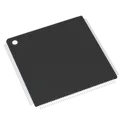
309 Uses0 StarsSTM32H573ZIT6
ARM® Cortex®-M33 STM32H5 Microcontroller IC 32-Bit 250MHz 2MB (2M x 8) FLASH 144-LQFP (20x20) # STM32H573ZIT6 ## General Description The STM32H573ZIT6 is a high-performance microcontroller from STMicroelectronics based on the Arm Cortex-M33 core. It is designed to deliver advanced processing capability, enhanced security, and extensive peripheral integration for industrial, medical, consumer, communications, and embedded control applications. The device combines powerful computational performance with low-power operation, making it suitable for real-time control, edge computing, human-machine interfaces, industrial automation, IoT gateways, motor control systems, and secure connected devices. Integrated security features, high-speed memory architecture, and comprehensive communication interfaces enable the development of robust and scalable embedded solutions. ## Key Features ### Processing Architecture * Arm Cortex-M33 processor core * TrustZone security architecture * Digital signal processing capabilities * Floating-point computation support * Optimized real-time processing performance ### Memory Resources * Embedded Flash memory * Integrated SRAM architecture * Error correction capability for enhanced reliability * High-speed memory access structure ### Security Features * Secure boot functionality * Hardware cryptographic accelerators * Secure firmware update support * Memory protection mechanisms * Tamper detection capabilities * Trusted execution environment * Secure key management support ### Communication Interfaces * USART and UART communication interfaces * SPI serial communication interfaces * I²C communication interfaces * CAN FD connectivity * USB connectivity support * Ethernet interface capability * SDMMC memory card interface * Flexible external communication options ### Analog Features * High-performance analog-to-digital conversion * Digital-to-analog conversion capability * Analog comparators * Precision signal acquisition support ### Timer and Control Functions * Advanced control timers * General-purpose timers * PWM generation capability * Encoder interface support * Motor-control functionality * Real-time clock integration ### Power Characteristics * Low-power operating modes * Dynamic power optimization * Battery-powered application support * Efficient performance-to-power ratio ### Package Characteristics * LQFP package construction * Surface-mount technology compatibility * Industrial-grade mechanical design * Suitable for automated assembly processes ### Application Areas * Industrial Automation Systems * Motor Control Equipment * Human-Machine Interfaces * Smart Energy Systems * Medical Electronics * IoT Gateways * Secure Embedded Devices * Industrial Networking Equipment * Building Automation Systems * Consumer Electronics * Data Acquisition Systems * Edge Computing Applications ### Compliance * RoHS Compliant * Lead-Free Compatible * Industrial and Commercial Application Support ## Manufacturer STMicroelectronics ## Product Family STM32H5 Series High-Performance Microcontrollers #STM32H573ZIT6 #STM32H5 #STMicroelectronics #CortexM33 #Microcontroller #EmbeddedSystems #IndustrialAutomation #SecureMCU #IoT #EdgeComputing #MotorControl #EmbeddedDesign #ElectronicsEngineering #FirmwareDevelopment #IndustrialElectronics
6 Uses0 StarsADF5611BCCZ
RF IC Synthesizer, VCO VSAT 7.3GHz ~ 14.6GHz SPI Interface 48-LGA (7x7) The ADF5611 allows implementation of fractional-N or integer-N phase-locked loop (PLL) frequency synthesizers when used with an external loop filter and an external reference source. The wideband microwave voltage controlled oscillator (VCO) design permits frequency operation from 7300MHz to 14,600MHz at a single RF output. A series of frequency dividers with a differential frequency output allows operation from 57MHz to 14,600MHz. Analog and digital power supplies for the PLL circuitry range from 3.15V to 3.45V, and the VCO supplies are between 4.75V and 5.25V. The ADF5611 has an integrated VCO with a fundamental frequency of 3650MHz to 7300MHz. These frequencies are internally doubled and routed to the RFOUT pin. An additional differential output allows the doubled VCO frequency to be divided by 1, 2, 4, 8, 16, 32, 64, or 128, allowing the user to generate RF output frequencies as low as 57MHz. A simple 3- or 4-wire serial port interface (SPI) provides control of all on-chip registers. To conserve power, this divider block can be disabled when not needed through the SPI. Likewise, the output power for both the single-ended output and the differential output are programmable. The integrated phase detector and Δ-Σ modulator, capable of operating at up to 100MHz, permit wide loop bandwidths and fast frequency tuning with a typical spurious level of −105dBc. With a VCO open-loop phase noise at an 100kHz offset from −115dBc/Hz at a 7.3GHz RFOUT to −109dBc/Hz at a 14.6GHz RFOUT, the ADF5611 is equipped to minimize blocker effects and to improve receiver sensitivity and transmitter spectral purity. The low phase noise floor eliminates any contribution to modulator and mixer noise floor in transmitter applications. ► RFOUT frequency range: 7300MHz to 14,600MHz ► PDIV_OUT and NDIV_OUT frequency range: 57MHz to 14,600MHz ► Fractional-N synthesizer and integer-N synthesizer modes ► Typical PFD spurious: <−105dBc ► Integrated RMS jitter at 1kHz to 100MHz integration bandwidth: <40fs ► Normalized inband phase noise floor FOM ► Integer mode: −232dBc/Hz ► Fractional mode: −229dBc/Hz ► Maintains frequency lock over −40°C to +85°C (lock and leave) ► Low phase noise VCO ► −115dBc/Hz typical at 100kHz (7.3GHz) ► −114dBc/Hz typical at 100kHz (10GHz) ► −109dBc/Hz typical at 100kHz (14.6GHz) ► RFOUT power (typical): 6dBm ► Programmable divide by 1, 2, 4, 8, 16, 32, 64, or 128 output ► Programmable output power level ► Typical power dissipation: 1W ► 48-terminal, 7 mm × 7 mm LGA package: 49 mm2 #ADF5611BCCZ #ADF5611 #FrequencySynthesizer #PLL #MicrowaveSynthesizer #RFIC #LowPhaseNoise #VCO #WirelessInfrastructure #SatelliteCommunication #MicrowaveRadio #TestAndMeasurement #AnalogDevices #RFDesign #ClockGeneration
0 Uses0 StarsSN65HVD75D
1/1 Transceiver Half RS422, RS485 8-SOIC These devices have robust 3.3-V drivers and receivers in a small package for demanding industrial applications. The bus pins are robust to ESD events with high levels of protection to Human-Body Model and IEC Contact Discharge specifications. Each of these devices combines a differential driver and a differential receiver which operate from a single 3.3-V power supply. The driver differential outputs and the receiver differential inputs are connected internally to form a bus port suitable for half-duplex (two-wire bus) communication. These devices feature a wide common-mode voltage range making the devices suitable for multi-point applications over long cable runs. These devices are characterized from –40°C to 125°C 1• Small-size VSSOP Packages Save Board Space, or SOIC for Drop-in Compatibility • Bus I/O Protection – >±15 kV HBM Protection – >±12 kV IEC 61000-4-2 Contact Discharge – >±4 kV IEC 61000-4-4 Fast Transient Burst • Extended Industrial Temperature Range –40°C to 125°C • Large Receiver Hysteresis (80 mV) for Noise Rejection • Low Unit-Loading Allows Over 200 Connected Nodes • Low Power Consumption – Low Standby Supply Current: < 2 µA – ICC < 1 mA Quiescent During Operation • 5-V Tolerant Logic Inputs Compatible With 3.3-V or 5-V Controllers • Signaling Rate Options Optimized for: 250 kbps, 20 Mbps, 50 Mbps • Glitch Free Power-Up and Power-Down Bus Inputs and Outputs 2 Applications • Factory Automation • Telecommunications Infrastructure • Motion Control #SN65HVD75D #RS485 #RS422 #Transceiver #TexasInstruments #IndustrialCommunication #FactoryAutomation #MotionControl #TelecomInfrastructure #ESDProtection #HalfDuplex #InterfaceIC #EmbeddedSystems #IndustrialElectronics #DataCommunication
127 Uses0 StarsW25Q128JVSIM
FLASH - NOR Memory IC 128Mb (16M x 8) SPI - Quad I/O, QPI, DTR 133 MHz 8-SOIC 128M-bit Serial Flash Memory with uniform 4KB sectors and Dual/Quad SPI Winbond W25Q128JV is a 128-Mbit (16 MB) serial NOR Flash memory device designed for code and data storage in embedded systems. It supports standard SPI, Dual SPI, Quad SPI (QSPI), and Dual/Quad Peripheral Interface (DPI/QPI) modes, enabling high-speed data transfer rates up to 133 MHz clock operation and up to 532 MB/s equivalent throughput in Quad I/O DTR mode. The device supports Execute-In-Place (XIP), allowing processors and microcontrollers to run code directly from external flash memory without copying it to RAM. Features include 4 KB sector erase, 32 KB and 64 KB block erase, page programming, hardware/software write protection, security registers, JEDEC identification, SFDP support, suspend/resume operations, and low-power standby modes. Suitable for microcontrollers, FPGA configuration storage, IoT devices, industrial controllers, networking equipment, consumer electronics, and embedded systems requiring reliable non-volatile memory. Search Keywords: W25Q128JV, Winbond flash memory, SPI NOR Flash, QSPI Flash, Quad SPI memory, Serial Flash memory, 128Mbit Flash, 16MB Flash memory, Execute In Place XIP, external MCU flash, ESP32 flash memory, FPGA configuration memory, NOR flash storage, W25Q128, Dual SPI Flash, Quad I/O Flash, embedded nonvolatile memory, serial flash IC Hashtags: #W25Q128JV #Winbond #NORFlash #SPIMemory #QSPI #SerialFlash #FlashMemory #EmbeddedSystems #Microcontroller #ESP32 #FPGA #NonVolatileMemory #XIP #IoT #ElectronicsDesign #MemoryIC #FirmwareStorage #QuadSPI #EmbeddedHardware #ElectronicComponents
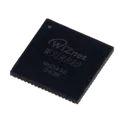
64 Uses0 StarsW55RP20
Ethernet ICs W55RP20 microcontroller, Dual ARM Cortex-M0+ a. 133MHz, 2MByte Flash memory on-chip, 264kB on-chip SRAM in six independent banks, DMA controller W55RP20 is a highly integrated System-in-Package (SiP) from WIZnet that combines the popular RP2040 dual-core microcontroller with a W5500 hardware TCP/IP Ethernet controller. Designed for IoT, industrial automation, and embedded networking applications, the W55RP20 delivers reliable Ethernet connectivity, low power consumption, and high-performance processing in a compact package. It simplifies Ethernet-enabled designs by integrating the MCU, network stack, flash memory, and Ethernet functionality into a single device. Key Features Dual-core ARM Cortex-M0+ processor running up to 133 MHz Integrated hardwired TCP/IP stack for reliable Ethernet communication 2 MB on-chip Flash memory 264 KB SRAM in six independent memory banks Built-in 10BASE-T / 100BASE-TX Ethernet MAC and PHY Supports TCP, UDP, IPv4, ICMP, ARP, IGMP, and PPPoE protocols 23 GPIO pins, including 4 analog-capable inputs 2× UART, 2× SPI, and 2× I²C interfaces 16 PWM channels and 8 Programmable I/O (PIO) state machines USB 1.1 Host/Device controller with integrated PHY 12-channel DMA controller for efficient data transfer Operating voltage range of 1.8 V to 3.3 V Industrial temperature support up to -40°C to +85°C Compact 68-QFN package for space-constrained designs #W55RP20 #WIZnet #RP2040 #EthernetMCU #IoT #EmbeddedSystems #IndustrialAutomation #TCPIP #EthernetController #Microcontroller #HardwareTCPIP #Networking #EmbeddedDesign #SmartDevices #IoTDevelopment
4 Uses0 StarsNRF54L15-CAAA-R7
IC RF TxRx + MCU 802.15.4, Bluetooth Bluetooth v5.4, Matter, Thread, Zigbee® 47-XFBGA, WLCSP # NRF54L15-CAAA-R7 ## General Description The NRF54L15-CAAA-R7 is an ultra-low-power wireless System-on-Chip (SoC) developed by [Nordic Semiconductor](https://www.nordicsemi.com?utm_source=chatgpt.com) for advanced Internet of Things (IoT), industrial, medical, smart home, and wireless sensing applications. The device integrates a high-performance Arm Cortex-M33 processor, a dedicated RISC-V coprocessor, large embedded memory resources, and a multiprotocol 2.4 GHz radio subsystem into a compact package. It is designed to provide exceptional energy efficiency, robust wireless connectivity, and enhanced security while supporting modern wireless standards including Bluetooth® Low Energy, Matter, Thread, Zigbee®, Bluetooth Mesh, Amazon Sidewalk, and proprietary 2.4 GHz protocols. The device is optimized for battery-powered applications requiring extended operating life, high processing capability, and scalable connectivity solutions. ## Key Features ### Processing Architecture * 128 MHz Arm® Cortex®-M33 application processor * Integrated 128 MHz RISC-V coprocessor * TrustZone® security architecture ### Memory Resources * 1.5 MB Non-Volatile Memory (NVM) * 256 KB RAM ### Wireless Connectivity * Multiprotocol 2.4 GHz RF transceiver * Bluetooth® Low Energy support * Matter support * Thread support * Zigbee® support * Bluetooth Mesh support * Amazon Sidewalk support * Proprietary 2.4 GHz protocol support * Bluetooth Channel Sounding capability * Compatible with Wi-Fi companion devices ### RF Performance * Data rates up to 4 Mbps * Output power up to +8 dBm * High receiver sensitivity for extended wireless range ### Security Features * Hardware cryptographic engine * Side-channel attack protection * Tamper detection mechanisms * Secure boot and secure firmware update support ### Peripheral Interfaces * SPI * I²C (TWI) * UART * I²S * GPIO * ADC * PWM * PDM * NFC * QDEC ### Power Characteristics * Ultra-low-power operation * Optimized sleep modes * Battery-powered application support * Operating supply voltage from 1.7 V to 3.6 V ### Package Information * WLCSP package * Surface-mount technology * Industrial operating temperature support ## Applications * Smart Home Devices * Industrial IoT Systems * Wearable Electronics * Medical and Healthcare Devices * Asset Tracking Solutions * Wireless Sensors * Building Automation Systems * Smart Lighting Controls * Consumer Electronics * Connected Peripheral Devices #NordicSemiconductor #nRF54L15 #NRF54L15CAAAR7 #BluetoothLE #Matter #Thread #Zigbee #IoT #WirelessSoC #EmbeddedSystems #IndustrialIoT #SmartHome #LowPowerDesign #CortexM33 #RISCV
9 Uses0 StarsSTM32MP157CAC3
ARM® Cortex®-A7 Microprocessor IC STM32MP1 2 Core, 32-Bit 209MHz, 650MHz 361-TFBGA (12x12) # Engineering Specification ## Product Name STM32MP157CAC3 ## General Description STM32MP157CAC3 is a high-performance microprocessor unit that combines application processing and real-time control capabilities within a single integrated circuit. The device is designed to support advanced embedded systems requiring a balance of computing performance, deterministic control, multimedia processing, connectivity, and security functionality. The component integrates multi-core processing resources, memory interfaces, graphics capabilities, peripheral controllers, and communication subsystems to enable the development of sophisticated embedded platforms. Its heterogeneous architecture allows high-level operating systems and real-time firmware to operate simultaneously, supporting applications that require both user-interface functionality and low-latency control. The device is intended for industrial automation, human-machine interface systems, edge computing platforms, communication equipment, medical devices, smart infrastructure, and Internet of Things applications. Its architecture enables consolidation of system functions, reducing component count and simplifying overall hardware design. The design emphasizes processing efficiency, system scalability, power management, security, and long-term reliability. It supports advanced software ecosystems and facilitates the development of connected embedded products with graphical interfaces, networking capabilities, and real-time operational control. ## Functional Requirements ### Application Processing The device shall provide application-level processing capabilities suitable for operating systems, middleware, and user applications. ### Real-Time Processing The device shall support deterministic control functions for time-critical embedded operations. ### Multimedia Support The component shall support graphical and multimedia processing functions for display and user-interface applications. ### System Integration The device shall integrate processing, communication, and peripheral functions within a unified embedded computing platform. ## Electrical Requirements ### Power Management The device shall support efficient power operation and multiple power management modes to optimize energy consumption. ### Memory Interface Support The component shall support external memory devices for program execution, data storage, and system operation. ### Peripheral Connectivity The device shall provide interfaces for communication, control, monitoring, and external subsystem integration. ### Signal Integrity The design shall support reliable operation across supported interface standards and operating conditions. ## Processing Architecture Requirements ### Multi-Core Operation The device shall support concurrent execution of application and real-time workloads through integrated processing resources. ### Operating System Support The architecture shall support embedded operating systems and software frameworks suitable for advanced application development. ### Security Features The device shall support hardware-based mechanisms intended to protect system integrity, software assets, and sensitive data. ### Resource Management The component shall support efficient allocation of processing, memory, and peripheral resources. ## Mechanical Requirements ### Surface Mount Construction The device shall be supplied in a high-density surface mount package suitable for automated manufacturing processes. ### PCB Integration The package shall support integration into multilayer printed circuit boards designed for high-performance embedded systems. ### Structural Integrity The device shall maintain electrical and mechanical reliability during assembly and operational service life. ## Environmental Requirements ### Operating Conditions The component shall operate reliably within environmental conditions commonly encountered in industrial and embedded applications. ### Thermal Performance The device shall support stable operation under sustained processing workloads and associated thermal conditions. ### Storage and Handling The component shall maintain physical and electrical integrity during transportation, storage, and manufacturing processes. ## Quality Requirements ### Reliability The device shall provide dependable long-term operation in embedded and industrial computing environments. ### Verification Processing, peripheral, communication, and system functions shall be validated through applicable testing and qualification procedures. ### Compliance The product shall conform to relevant semiconductor, quality, and embedded computing standards applicable to its intended use. ## Documentation Requirements Technical documentation shall include processor architecture information, hardware integration guidelines, memory interface recommendations, power management considerations, software development support, security features, and application design guidance. ## Classification Tags #STM32MP157CAC3 #STM32MP1 #Microprocessor #MPU #EmbeddedProcessor #ARMProcessor #EmbeddedLinux #RealTimeControl #IndustrialAutomation #HumanMachineInterface #EdgeComputing #IoTGateway #EmbeddedSystems #SystemOnChip #SoC #ApplicationProcessor #GraphicsProcessor #ConnectivityPlatform #IndustrialElectronics #PCBDesign #HardwareDevelopment #ElectricalEngineering #CommonPartsLibrary #ComponentLibrary #EngineeringSpecification #TechnicalDocumentation #SystemIntegration #SecureEmbeddedSystems #MulticoreProcessing
9 Uses0 Stars