Interface ICs
An interface IC is a type of integrated circuit that is designed to facilitate communication between two devices or systems. These devices are commonly used in electronic systems to enable the transfer of data and control signals between different components or subsystems. Some common use cases for interface ICs include connecting microcontrollers to peripherals such as sensors or displays, linking multiple processors together in a network, and enabling communication between devices using different communication protocols. Flux.ai has the world's largest community-driven public library of interface ICs, with footprints, symbols, datasheets, and simulation models. This library is a valuable resource for engineers and designers who need access to accurate and up-to-date information on these important components. Whether you are working on a new design project or simply looking to learn more about interface ICs, Flux.ai is an excellent resource to help you find the information you need.
Light-sensitive LED Module
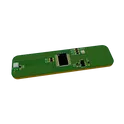
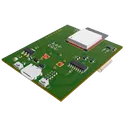
This is a light-sensitive LED reference design featuring an STM32L031F4P6 microcontroller. It interfaces with a TEMT6000X01 light sensor and controls a multi-colored LED. The system also has a user button and UART for communication, and regulators to manage power supply. #referenceDesign #reusable #module #simple-embedded #light-sensitive #module #sublayout
12 Uses1 StarsTJA1051TK Module
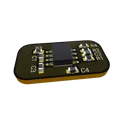
This TJA1051TK-based reference design is a CAN bus transceiver circuit, providing reliable data communication over the CAN network. The design features a range of capacitors and resistors to ensure signal integrity, and a NUP2105L for voltage protection. It's ideal for applications requiring reliable data communication in an automotive or industrial environment. #referenceDesign #Module #CANbus #interface #transceiverCircuit #TJA1051TK/3,118 #TJA1051TK #reusable #module #canbus #nxp #sublayout
6 Uses1 StarsADM3054BRWZ-RL7 Module
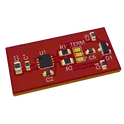
This ADM3054BRWZ-RL7-based reference design is a CAN bus transceiver circuit, providing reliable data communication over the CAN network. The design features a range of capacitors and resistors to ensure signal integrity, and a NUP2105L for voltage protection. It's ideal for applications requiring reliable data communication in an automotive or industrial environment. #referenceDesign #module #CANbus #interface #transceiverCircuit #ADM3054 #ADM3054BRWZ-RL7 #reusable #module #canbus #texas-instruments #sublayout
3 Uses1 StarsE-ink Smart Thermostat Module
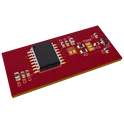
This project is a Smart Thermostat design using an ESP32 module for WiFi connectivity and a BME680 sensor for environmental monitoring. The user interface includes an E-ink display and an encoder for settings adjustment. Power is managed through a USB-C connector with a 3.3V regulator. #referenceDesign #project #ESP32 #ESP32WROOM #RF #WIFI #MCU #thermostat #reusable #module #edge-computing #edgeComputing #espressif #sublayout
18 Uses1 Stars