Top User Components
Discover the most popular and effective components used in cutting-edge PCB designs on Flux.ai. This collection showcases the components that have been integral to the success of our community's most innovative printed circuit board designs. Ranging from simple resistors to complex integrated circuits, these components represent the best in terms of functionality, reliability, and performance. It’s a treasure trove for anyone looking to enhance their PCB layout and designs with proven, high-quality components. It's an excellent resource for gaining insights into the component preferences of skilled designers and understanding why certain components stand out in the realm of electronic design. Whether you're refining your current project or starting a new one, these components offer valuable inspiration and a benchmark for quality. By spotlighting the components chosen by our top users, Flux.ai not only celebrates the ingenuity of its community but also fosters a culture of sharing and learning. This subcategory is a testament to the collaborative spirit at Flux.ai, encouraging continuous improvement and exploration in electronic component selection.


Red Right Angle LED
1.6k Uses3 Stars


Power Inverter
The inverter specs are Switching frequency: 200kHz Input voltage: 180VDC Output voltage: 120VAC Max power: 1500W I have designed an Inverter schematic for an uninterruptible power supply (UPS), Used an efficiency LCL topology filter to eliminate 3rd and 5th harmonics as induction motor is connected at load. The Inverter schematic that can convert 180VDC into 120VAC, which can be used in any household or industrial application. You can refer the BOM to check the MOSFET parts, drivers, and filter parameter values.
0 Uses3 Stars

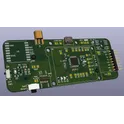
![[Example] STM32F4x Preliminary Design](https://img-cdn.flux.ai/eyJidWNrZXQiOiJncmF2aXRvbi1lbGVjdHJpYy1zeW1ib2xzIiwia2V5IjoiZG9jdW1lbnRfYXNzZXRzL3N0bTMyZjQtNjg5MjllYTEtNmZmZC1kMzhjLWQ5NDAtODY2ZDA3MTU1MjIyLnBuZyIsImVkaXRzIjp7InJlc2l6ZSI6eyJ3aWR0aCI6MTI0LCJoZWlnaHQiOjEyNCwiZml0IjoiY29udGFpbiIsImJhY2tncm91bmQiOnsiciI6MCwiZyI6MCwiYiI6MCwiYWxwaGEiOjB9fX0sIm91dHB1dEZvcm1hdCI6IndlYnAifQ==)









![[Example] ESP32 Reference Design](https://img-cdn.flux.ai/eyJidWNrZXQiOiJncmF2aXRvbi1lbGVjdHJpYy1zeW1ib2xzIiwia2V5IjoiZG9jdW1lbnRfYXNzZXRzL2VzcDMyLWM3OGU1YTg3LThmNzgtMGVkZS1mODc3LTYwZjdiMDM0MjRkNS5wbmciLCJlZGl0cyI6eyJyZXNpemUiOnsid2lkdGgiOjEyNCwiaGVpZ2h0IjoxMjQsImZpdCI6ImNvbnRhaW4iLCJiYWNrZ3JvdW5kIjp7InIiOjAsImciOjAsImIiOjAsImFscGhhIjowfX19LCJvdXRwdXRGb3JtYXQiOiJ3ZWJwIn0=)