Top Organization Components
Curated collection features components used in significant projects by various businesses and institutions, reflecting the current trends and high standards of the industry. From basic electronic elements to advanced modules, these components are selected for their superior quality, efficiency, and adaptability in diverse applications. It offers a glimpse into the components that are shaping the future of PCB design in professional settings. It serves as a vital resource for designers and organizations looking to stay ahead of the curve, providing insights into the component choices that lead to successful and innovative designs. By showcasing the preferred components of leading organizations, Flux.ai creates an avenue for knowledge exchange and benchmarking within the electronics design community. This subcategory is more than just a list of components; it's a reflection of industry-leading practices and a source of inspiration for those striving for excellence in PCB design.
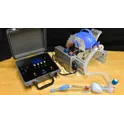
MIT Emergency Ventilator Project
An open source ventilator created by a team at MIT as an emergency response to the growing need for ventilators during the COVID-19 pandemic. Please read through all documentation and safety information linked in the properties before using any device in a clinical setting.
1 Uses2 Stars-59934b57-113a-1922-4834-67d18f6a5aae.svg)
Autonomous "Follow Me" Cooler
An Arduino Uno powers this autonomous “follow me” cooler that connects to a smartphone via Bluetooth and uses GPS to navigate. The robot cooler connects to a smartphone via Bluetooth and uses GPS to navigate. All the electronics will be contained in the base so that other objects can be carried as well. The electronics were installed in the box cutout under the platform. An Arduino Uno and a 5v battery to power the sensors, Bluetooth, and control logic. A 3s LiPo battery was used to power the motors. A HC-05 Bluetooth module was mounted at the front of the platform for better range. The rest of the components including a L298N motor driver, PAM-7Q GPS, and HMC6883L compass were mounted inside and connected to the Arduino through the breadboard. The compass works with I2C, so we connected the SLC and SDA pins to A5 and A4 respectively. The rest of the pins were connected through digital I/O.
0 Uses2 StarsSimple Microphone Amplifier Circuit
0 Uses2 StarsLM303 Gyro
3 Uses2 Stars
16-Channel Analog Multiplexer
This is a breakout board for the very handy 16-Channel Analog/Digital Multiplexer/Demultiplexer CD74HC4067. This chip is like a rotary switch - it internally routes the common pin (COM in the schematic, SIG on the board) to one of 16 channel pins (CHANxx).
62 Uses2 StarsFaint Red Time Machine
0 Uses2 Stars
Quadraped Robot
0 Uses2 StarsAssociated Teal Universal Remote
1 Uses2 StarsAT-TINY-13A
2 Uses2 Stars