Top Organization Components
Curated collection features components used in significant projects by various businesses and institutions, reflecting the current trends and high standards of the industry. From basic electronic elements to advanced modules, these components are selected for their superior quality, efficiency, and adaptability in diverse applications. It offers a glimpse into the components that are shaping the future of PCB design in professional settings. It serves as a vital resource for designers and organizations looking to stay ahead of the curve, providing insights into the component choices that lead to successful and innovative designs. By showcasing the preferred components of leading organizations, Flux.ai creates an avenue for knowledge exchange and benchmarking within the electronics design community. This subcategory is more than just a list of components; it's a reflection of industry-leading practices and a source of inspiration for those striving for excellence in PCB design.
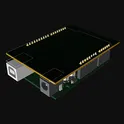
Arduino Uno R3 Shield Max485 Double
Template for Arduino Uno R3 Shield. Include an official pinout so you will always know Arduino names, the alternative roles of pins, which one is SDA, or SCL, etc. On PCB you can find the 3D model of the Arduino Uno R3 itself along with the board outline on the silkscreen. #Arduino #Uno #Shield #Template #project-template #project
3.2k Uses5 Stars
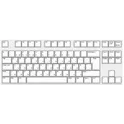
83 Keyboard
A 83 key keyboard, Norwegian QWERTY/DVORAK ISO style. It's of course possible to use other languages, as the MX cherry switches will accept keycaps with whatever language you need. It uses 83 1N4148 diodes and three LED's for caps lock,scroll lock, and QWERTY/DVORAK. It also needs pin headers that accepts the pins from a Teensy++2.0
0 Uses5 Stars

-59934b57-113a-1922-4834-67d18f6a5aae.svg)
Autonomous "Follow Me" Cooler
An Arduino Uno powers this autonomous “follow me” cooler that connects to a smartphone via Bluetooth and uses GPS to navigate. The robot cooler connects to a smartphone via Bluetooth and uses GPS to navigate. All the electronics will be contained in the base so that other objects can be carried as well. The electronics were installed in the box cutout under the platform. An Arduino Uno and a 5v battery to power the sensors, Bluetooth, and control logic. A 3s LiPo battery was used to power the motors. A HC-05 Bluetooth module was mounted at the front of the platform for better range. The rest of the components including a L298N motor driver, PAM-7Q GPS, and HMC6883L compass were mounted inside and connected to the Arduino through the breadboard. The compass works with I2C, so we connected the SLC and SDA pins to A5 and A4 respectively. The rest of the pins were connected through digital I/O.
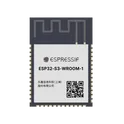
0 Uses5 StarsESP32-S3-WROOM-1-N16R8
The ESP32-S3-WROOM-1-N16R8 is a high-performance Wi-Fi and Bluetooth Low Energy (BLE) module from Espressif Systems, built around the ESP32-S3 SoC. It integrates a dual-core Xtensa® LX7 processor running at up to 240 MHz, along with 16 MB Quad SPI Flash and 8 MB Octal SPI PSRAM, making it suitable for memory-intensive embedded, IoT, AIoT, multimedia, and edge AI applications. The module includes an onboard PCB antenna, RF matching circuitry, crystal oscillator, and flash/PSRAM, simplifying hardware design and reducing development time. Key Features Dual-core Xtensa LX7 CPU operating up to 240 MHz 16 MB onboard Flash memory 8 MB onboard Octal PSRAM for large buffers, graphics, and AI workloads 2.4 GHz Wi-Fi (IEEE 802.11 b/g/n) Bluetooth 5.0 Low Energy (BLE) Built-in support for AI acceleration and vector instructions for machine learning and signal processing applications Rich peripheral set including: GPIO UART SPI I²C I²S USB 2.0 OTG PWM ADC Touch sensing SD/MMC interface CAN (TWAI) Integrated USB Serial/JTAG debugging capability Supply voltage range: 3.0 V to 3.6 V Operating temperature: −40°C to +65°C Surface-mount module with integrated PCB antenna Supports secure boot, flash encryption, and hardware cryptographic acceleration for secure IoT devices. Typical Applications Smart home and IoT devices Edge AI and machine learning Voice assistants and speech recognition Industrial automation Human-machine interfaces (HMI) Wireless sensors and gateways Smart displays and touch panels Audio streaming and multimedia devices Robotics and connected products #RF-Transceiver #Module #ESP32
335 Uses4 Stars
Biskuit AI: Project Showcase
Kitchen LED Strip Motion & Ambient-Light Controller with 12 V PWM Dimming, PIR Sensor, Ambient Light Sensor, MCU Control, Buck Regulator, and Protection Circuits (TVS, PTC Fuse, Reverse-Polarity Diode) #KitchenLEDController #MotionDetection #AmbientLightSensor
0 Uses4 Stars